
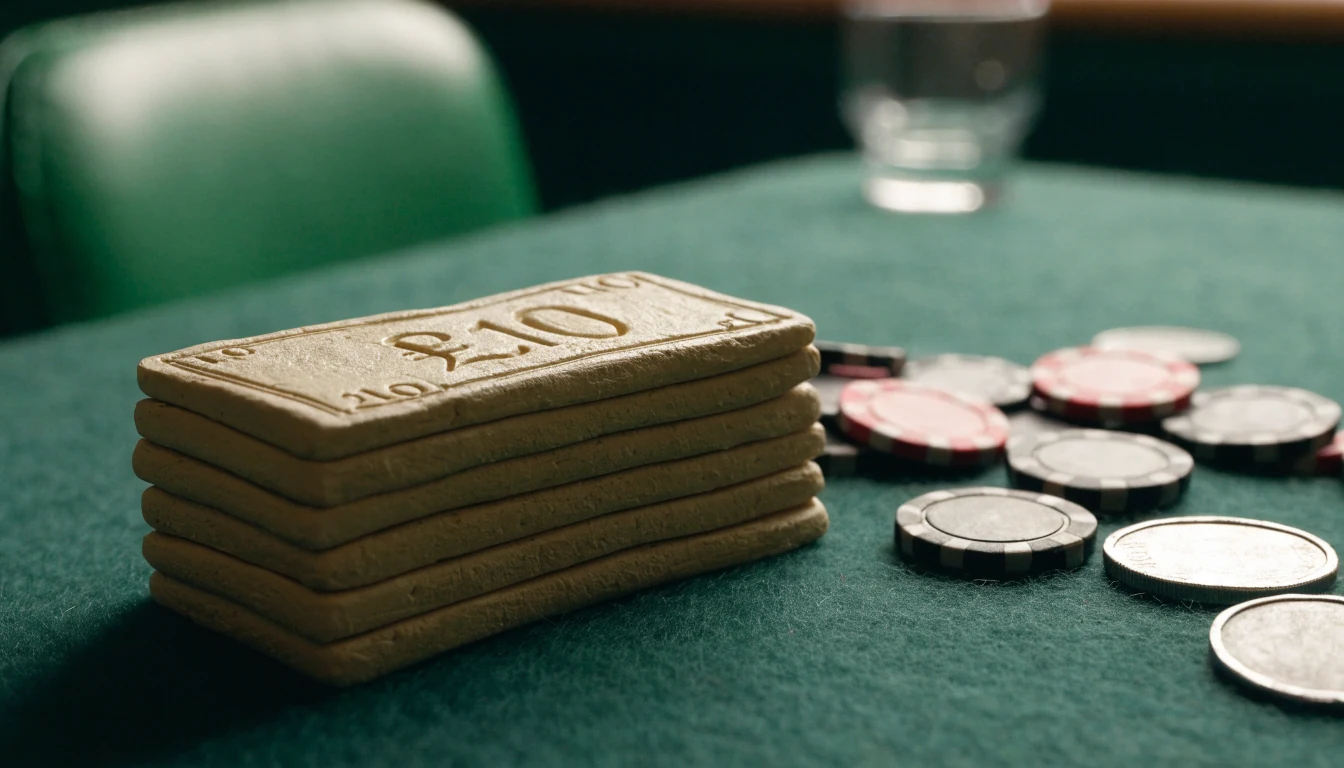
A £10 minimum is a cashier threshold, not a requirement to register or a guarantee that a welcome bonus will apply.
What a £10 Minimum Deposit Actually Means
A £10 minimum deposit is a cashier rule. It means the casino will not process a deposit below £10 through the relevant cashier route. It does not mean that every account must contain £10 before registration, that every game costs £10 to play, or that a £10 payment automatically unlocks a welcome offer.
That distinction matters because casino pages often compress several conditions into one promotional phrase. “£10 minimum deposit” describes the funding threshold. The account-opening process, the payment method and the bonus rules are separate parts of the arrangement.
The cashier threshold
At a casino accepting direct banking, the typical minimum deposit is £10, according to a specialist review. That is a reference point, not a universal rule. Some operators set the cashier minimum at £5, while others require £20.
The amount shown in the cashier is the operative figure. A general page may describe a £10 minimum deposit casino, but the payment screen can apply a different threshold to a particular route. The minimum is therefore best understood as an operator setting attached to the deposit function, rather than a legal definition of a casino with a £10 minimum deposit.
At a given operator, the threshold is generally the same across payment methods. There is an important qualification: some casinos impose a higher minimum on direct banking than on cards or e-wallets. The account may therefore support a £10 deposit through one route while displaying another amount after a different option is selected.
That is why a headline alone is insufficient. The cashier is where the active rule appears.
Deposit required to open an account
Opening an account and funding it are separate stages. Registration normally involves entering personal details and completing the operator’s onboarding checks. The deposit threshold applies when money is added, not simply when the account record is created.

For British customers, age verification must take place before funds can be deposited into a gambling account. UK players must be at least 18. A £10 minimum deposit does not bypass either requirement. It is only the smallest permitted payment under that cashier rule once the account is available for gambling transactions.
This also prevents a common misunderstanding: a casino advertised as a “10 pound minimum deposit casino” is not necessarily asking for £10 merely to create a profile. The phrase concerns the first or subsequent deposit amount accepted by the cashier. Registration and payment should be read as different checkpoints.
From the operator side, this separation is deliberate. Account creation establishes identity and eligibility; the cashier controls how much money can enter the account in one transaction. One condition does not replace the other.
A £10 deposit is not a £10 bonus qualification
The promotional threshold can be different from the banking threshold. A casino may technically accept £5 deposits while a particular welcome offer requires a qualifying deposit of £10, as noted in a specialist review. In that case, a £5 payment can be accepted and still fail to trigger the promotion.
The reverse can also create confusion in the wording. A £10 cashier minimum does not prove that a welcome offer is available. Some offers may have separate qualifying conditions, while an account can be funded without taking part in a promotion. The deposit amount and the promotional eligibility rule must therefore be checked independently.
I have seen this treated as a minor wording issue. It is not. The difference changes what the payment achieves:
- the cashier minimum determines whether the transaction can be accepted;
- the qualifying-deposit condition determines whether a promotion can be activated;
- the account terms determine whether the customer is eligible at all.
A payment can satisfy one condition without satisfying the others. That is the practical meaning behind the phrase “minimum £10 deposit casino UK”: the £10 figure may describe banking access, promotional eligibility, or both, but only the specific terms identify which.
What the threshold does not tell you
The £10 figure says nothing by itself about game stakes, withdrawal rules, payment processing, or the value of any promotion. It is also not a statement that the deposited money is risk-free or that a particular result will follow. The balance remains real money, and any play is governed by the casino’s account and game terms.
Nor does the threshold establish that every available payment route will show precisely the same cashier setting. The general position at one operator may be consistent, yet a higher direct-banking minimum can still apply. The selected route has to be checked at the point of payment.
For the same reason, an advertised £10 minimum deposit should be read as a narrow statement: this is the amount the operator accepts as the minimum under the stated cashier conditions. It is not a complete description of account eligibility or promotional value.
The cleanest reading is simple: £10 opens the cashier, not the offer.
How £10 Deposits Work on Online and Mobile Casinos
A £10 deposit is not the same thing as £10 placed on a game. The cashier records a payment first; the casino then applies its account rules before the balance becomes available for play. On a desktop site, the process runs through the cashier page. On a mobile casino, the same account and wallet are normally accessed through a mobile browser or an operator’s app where one is provided. The screen changes. The underlying transaction does not.
I have seen many misunderstandings begin with the phrase “instant balance”. It describes the account display, not necessarily the whole gambling journey. A successful card or e-wallet payment may appear as cash in the wallet, while a separate bonus balance, pending verification check or account restriction affects what can actually be used.
From cashier payment to playable funds
The usual sequence is straightforward:
- The account is opened and the operator completes the required age and identity checks.
- A financial limit is set before the first deposit.
- The cashier displays the available deposit route and its minimum.
- A £10 payment is authorised and credited to the account.
- The wallet labels the funds as real money, bonus money or a combination of both.
- A game can be opened only with the part of the balance permitted for that game.
The important distinction is between a completed payment and an unrestricted playable balance. A deposit may be held for review, returned, or left unavailable while account information is checked. That is not the same as the casino taking the money and allowing play. The account history and wallet labels show which stage has been reached.
On mobile, the smaller screen makes this easier to miss. A cashier may show a single “deposit” button while the terms, balance type and withdrawal conditions sit behind separate links. The mobile version should therefore be treated as a full banking interface, not as a simplified shortcut. The same operator controls remain relevant: deposit limits, session tools, account verification and the internal complaints route.
What £10 can do in a casino wallet
Once the amount is available as cash, it can be used for eligible real-money games. Many online slots accept stakes between £0.10 and £0.20 per spin. At those levels, the balance is divided into individual wagers rather than consumed by one large transaction. A lower stake can keep the balance in play for longer, but it does not change the outcome of any spin or create a guaranteed playing time.
The displayed balance also moves after each result. A losing spin reduces it; a winning spin increases it, subject to the game’s rules and any separate restrictions attached to the funds. If the wallet falls below the game’s selected stake, the spin cannot be started until another deposit is made. A £10 cashier minimum does not mean that every game requires £10 to begin. It is a banking threshold, not a game stake.
Understanding Playable Funds
A deposit is not immediately an unrestricted balance. Once the £10 is credited, the funds are labeled as real money or bonus money, and subject to account verification and game-specific requirements.
The distinction matters on mobile devices because games often open immediately after a tap. A quick route from cashier to slot can make the deposit feel like a purchase of spins. It is not. The money remains a cash balance until a wager is accepted, and each spin is a separate gambling transaction.
Withdrawals are a separate checkpoint
A playable balance is not automatically a withdrawable balance. The cashier may apply a minimum withdrawal amount, identity checks, payment-return rules and any outstanding account review. A specialist review of UK casinos places the minimum withdrawal thresholds reported by many operators between £10 and £20, but this is a changing operator condition rather than a permanent market rule. The cashier’s current withdrawal screen is the controlling detail.
This creates a practical issue with a small deposit. If the balance rises but remains below the operator’s withdrawal threshold, the withdrawal request may not proceed. A £10 deposit can therefore be available for play while the resulting balance still has to meet a separate cash-out condition. If the balance reaches the stated threshold, the operator may still require verification before releasing funds.
The route used for withdrawal can also matter, but that belongs to the cashier rules rather than the game itself. The account history should show the deposit, wagers, results and withdrawal request as separate entries. That record is more useful than the headline attached to the casino’s deposit button.
 £2 Minimum Deposit Casino UK: What to CheckLearn what a £2 deposit allows, why payment methods have different minimums, and how deposit, stake and withdrawal rules are separate.
 iPad Casinos UK: Browser Play, Games and PaymentsLearn how iPad casinos work in a browser, what makes their layouts usable, and what to check in game access, cashier options…
Responsible controls remain active
Low-entry play does not remove the account safeguards that apply to larger balances. UK-licensed operators must provide account-level limit controls and prompt new customers to set a financial limit before the first deposit. Online slots in Britain cannot use autoplay, and each spin must last at least 2.5 seconds. The maximum slot stake per game cycle is £5 for customers aged 25 and over, and £2 for those aged 18 to 24.
These controls affect the playing session after the £10 reaches the wallet. They are not obstacles added by the payment process; they define how online slot play operates in the British market. I regard the limit-setting prompt as part of the deposit journey, not an optional message to dismiss.
Small deposit, separate stages.
Payment Methods: Cards, E-Wallets and Bank Transfers
A £10 minimum deposit casino is describing the amount accepted at the cashier, not a special type of payment account. The available routes still matter because each one passes through a different approval and processing path. In Britain, the compliant choices are debit cards, e-wallets funded from debit sources, and direct banking from a bank account. Credit cards cannot be used for gambling deposits.
Debit cards
Visa and Mastercard debit cards are the most broadly supported option across UK-facing casino cashiers. They are familiar to operators, connect directly to a bank account and commonly support low cashier minimums, including a £10 deposit where that is the stated threshold.
The transaction normally follows a short sequence:
- The card is selected in the cashier.
- The card details and deposit amount are entered.
- The payment is authorised by the issuing bank.
- The casino credits the approved amount to the gambling balance.
The name on the card must correspond with the account holder’s verified identity. A failed payment does not necessarily mean that the casino rejects £10 deposits. The bank may have declined the transaction, the card may not be enabled for online payments, or the operator may require an additional security check.
The important distinction is between a debit card and a credit card. The UK Gambling Commission’s ban on credit-card gambling, introduced in 2020, prevents credit cards from being used for these deposits. A card that looks similar at the checkout is not automatically permitted: the funding source is what matters.
E-wallets funded by debit
E-wallets provide another route for a £10 deposit, but they do not bypass the underlying funding rules. An e-wallet used for gambling must be funded from an acceptable source, such as a debit card or bank account. A wallet that allows credit-card funds to be used for gambling is not a compliant workaround.
The payment flow differs from a card transaction. The casino sends the customer to the wallet’s authorisation screen, where the wallet balance or linked funding source is confirmed. The casino then receives the payment confirmation rather than the full card details. This can be useful where a customer prefers not to enter card information directly into each cashier.
The operator may display the same £10 minimum for cards and e-wallets. That is common, but it is not guaranteed. The cashier controls the actual threshold, and a method can be unavailable even when the casino supports another route. An e-wallet may also have its own account, verification or funding rules separate from those shown by the casino.
PayPal belongs in this general category, although availability is operator-specific. Its presence on one UK casino cashier says nothing about another casino’s payment menu. The relevant question is not whether an e-wallet is widely known, but whether the particular operator accepts it for deposits and under which conditions.
Direct banking
Direct banking moves money from a bank account to the operator without using a card checkout or a separate wallet. In the cashier, this may appear as bank transfer or online banking, but the practical issue is the same: the payment originates from the customer’s bank account.

This route can require more information than a card deposit. The casino may provide account details or an electronic banking connection, while the bank may request its own confirmation before releasing the funds. The payment reference must be entered accurately when one is supplied, because it helps the operator match the incoming money to the correct gambling account.
A £10 cashier threshold may apply to direct banking just as it does to cards and e-wallets. Some operators, however, place a higher minimum on bank transfers than on the other methods. That difference is a cashier rule, not a general feature of bank transfers. The same casino can therefore show one threshold for a debit card and another for direct banking.
Why the same casino can show different minimums
The deposit limit is set at operator and method level. Many UK casinos keep one minimum across the available payment choices, making a £10 deposit possible regardless of whether the transaction uses a debit card, an eligible e-wallet or direct banking. Others separate the methods because of processing arrangements, reconciliation work or the way the payment provider handles smaller transactions.
The cashier is therefore more reliable than a promotional description. Before confirming a payment, the selected method should be checked for:
- the minimum and maximum transaction values displayed;
- whether the method is available to the account;
- the required account or cardholder name;
- any verification step requested by the operator or payment provider;
- whether the payment is a deposit route rather than a withdrawal route.
A displayed £10 minimum applies to that particular transaction path. Changing from a debit card to direct banking can change the threshold, even when both options appear under the same cashier.
What cannot be used
Credit cards are excluded from gambling deposits in Britain, including arrangements that attempt to route credit-card funds through another payment service. The same principle applies to an e-wallet whose balance is funded by credit for gambling purposes.
That leaves a straightforward compliant structure: a debit card, an eligible e-wallet funded from debit or bank money, or direct banking from a bank account. The £10 figure only describes the amount accepted by the operator; it does not relax the rules governing where the money comes from. Small threshold, same controls.
Comparing £1, £5, £10 and £20 Deposit Tiers
The cashier minimum changes the entry point, not the quality of the casino or the likely result of a game. The practical difference is how much money must leave the bank account before the account can be funded, and whether that threshold works with the intended payment route.
£1 Tier
Rare and potentially limited by specific cashier conditions.
£5 Tier
Lower entry point, though promotion rules may differ.
£10 Tier
A common reference point, particularly for direct banking.
£20 Tier
A higher initial commitment for regular players.
A £1 minimum deposit is the lowest tier available in Britain, but it is uncommon. A specialist review verified six UK Gambling Commission-licensed casinos accepting a genuine £1 deposit. That figure should be treated as a dated check, not as a permanent market count. Low thresholds can also be restricted by cashier rules, so the headline minimum may not apply to every payment option.
The £5 tier sits between the rare £1 facility and the more familiar £10 level. It reduces the initial outlay, but it does not necessarily provide the same access to promotions or payment methods. A platform may accept £5 for ordinary funding while applying a different qualifying deposit to an offer. That is a separate commercial condition.
The £10 tier is the clearest reference point for direct banking. A specialist review of UK casino cashier terms described £10 as the typical direct-banking minimum, with some operators setting the threshold at £5 and others at £20. This makes a casino with a £10 minimum deposit a middle-ground option: not the smallest possible entry, but below the higher cashier tier.
A £20 minimum deposit requires more capital at the outset. It may suit an account already intended for regular play, but it is a poor match where the purpose is simply to test the cashier or keep the first transaction modest. The larger threshold does not, by itself, indicate better games, stronger safeguards or more favourable terms.
| Tier | Practical position |
|---|---|
| £1 | Rare and potentially limited by cashier conditions |
| £5 | Lower entry point, but promotion rules may differ |
| £10 | Common reference point for direct banking |
| £20 | Higher initial commitment |
The sensible comparison is therefore not “lowest is best”. It is whether the cashier minimum matches the planned payment method, the desired first-deposit amount and the account’s promotional conditions. A £10 minimum deposit casino in the UK can be more suitable than a £1 option if the latter carries restrictions that change how the account can be used. Threshold first. Marketing second.
Welcome Bonuses on a £10 Deposit: The Terms Behind the Headline
A £10 minimum deposit does not automatically mean that a £10 payment unlocks the advertised welcome offer. The cashier threshold and the promotional threshold are separate rules. A casino may accept the deposit for real-money play while setting a different qualifying amount for its bonus.
The important wording is normally found under headings such as “eligible deposit”, “minimum qualifying deposit” or “bonus activation”. A promotion might require the account holder to opt in, make the qualifying deposit within the stated promotional period and avoid withdrawing before the bonus is credited. The headline gives the marketing version; the terms determine whether the offer attaches to the transaction.
What the wagering requirement changes
A bonus is not the same as withdrawable cash. The wagering clause says how much eligible play must be completed before bonus funds, and sometimes related winnings, can be withdrawn. Requirements commonly seen in older casino terms ranged from 30x to 65x the bonus value. Since 19 January 2026, however, the UK Gambling Commission has capped bonus wagering at 10x.
That cap does not remove the need to read the rest of the offer. A lower multiplier can still sit beside a restricted game list, a maximum bet rule, an expiry condition or a maximum withdrawal cap. The arithmetic is only one part of the offer.
For instance, if the terms calculate wagering against the bonus rather than the deposit, the qualifying £10 payment is not itself the amount multiplied. That distinction is easy to miss in a banner and obvious in the full conditions. I have seen the deposit amount and bonus amount discussed in adjacent lines, which makes the promotion look more generous than its playable structure really is.

Game weighting and withdrawal limits
Not every game necessarily contributes equally to bonus wagering. The terms may identify eligible slots while excluding table games, live casino games or particular titles. A slot-only requirement can therefore make a promotion unsuitable for someone who intended to use the balance elsewhere.
Maximum withdrawal caps matter as well. Where such a cap applies, it concerns the bonus arrangement and not the payment route used to fund the account. The same principle applies to wagering requirements and game restrictions: these conditions attach to the bonus amount, not to whether the qualifying payment arrived through direct banking, a card or an e-wallet.
Direct banking deposits can qualify for a welcome bonus on the same basis as card or e-wallet deposits at UK-licensed casinos. The promotional conditions should therefore be compared by their qualifying amount and restrictions, rather than by the banking method.
A practical reading order
For a £10 minimum deposit casino bonus, the useful order is:
- Check whether £10 is both the cashier minimum and the qualifying deposit.
- Confirm that the offer must be activated before depositing.
- Read the wagering calculation and the games that contribute.
- Check the maximum withdrawal cap and any expiry condition.
- Separate the deposit balance from the bonus balance.
“10 pounds in, bonus on” is the headline. The conditions are the product.
Real-Money Play: What a Small Balance Can Cover
A £10 deposit becomes real-money balance only after the cashier confirms the transaction and the funds appear in the gambling account. It is not a bonus balance and does not carry promotional wagering conditions merely because it was deposited. The practical question is how long that balance may remain in play at the selected stake.
Many online slots offer spins priced between £0.10 and £0.20. At £0.10 per spin, £10 represents 100 spins if every spin loses and no winnings are returned. At £0.20, the same balance covers 50 spins under that same simple calculation. Those figures describe stake capacity, not an expected result. A slot can return winnings during play, but it can also reduce the balance quickly.
I have always treated the displayed balance and the usable stake as separate things. A player may see £10 in the account, yet a portion can be tied up in an unsettled round or subject to a transaction already in progress. The game screen, rather than the deposit receipt, shows what is available for the next spin.
Do
- Check the cashier for the specific method’s minimum
- Set a financial limit before your first deposit
- Verify the operator’s UKGC licence status
Don’t
- Assume a £10 deposit automatically triggers a bonus
- Use credit cards for any gambling transactions
- Ignore the difference between real and bonus money
“Small balance” does not mean “small risk”. Repeated low-value spins still consume funds, and increasing the stake changes the pace at which the balance is used. British online slots also cannot run on autoplay, so each spin requires an active decision. That makes the running balance visible, but it does not change the game’s outcome.
Withdrawal rules matter as well. A specialist review of UK casino terms reported minimum withdrawal thresholds of £10 to £20 at many operators. That is not a universal market rule, so the cashier conditions need checking before play. A £10 balance may therefore be enough to start real-money play without being enough to request a withdrawal at a casino applying the higher threshold.
The clean distinction is simple: the deposit buys access to the cash balance; the stake determines how quickly it is exposed. Keep those two mechanics separate.
PayPal and the £10 Minimum: Check the Cashier Rules
PayPal can appear in a casino cashier without accepting the same minimum deposit as a debit card. The important figure is set by the operator for that payment route, not by the phrase “PayPal casino” itself. A site may advertise a £10 minimum deposit while applying that threshold across its available methods, or it may display a different cashier minimum once PayPal is selected.
I have always treated the cashier screen as the operative rule. Promotional pages and review summaries can describe a general minimum, but the payment panel determines whether PayPal is available to the account, what the minimum is, and whether the transaction can proceed. Those details may also depend on the customer’s location and account status.

At a given UK operator, the minimum deposit is generally kept consistent across payment methods. There is an important qualification: some casinos set a higher threshold for direct banking than for cards or e-wallets. That makes it unsafe to assume that a £10 minimum shown beside one method automatically applies to PayPal, or that PayPal will be available at every casino carrying the same headline.
The funding source matters as well. UK gambling operators cannot accept credit-card deposits. The permitted routes include debit cards, e-wallets funded by debit, and bank accounts. PayPal therefore has to be used in a way that does not introduce credit-card funding into the gambling transaction. A wallet balance funded from a credit card does not turn that payment into a compliant deposit route.
The practical check is short: open the cashier, select PayPal, read the displayed minimum, and inspect any payment-specific conditions before confirming. If the cashier shows £10, that is the relevant threshold for that transaction. If PayPal is absent, another payment route is required. No assumption fills that gap.
Checking That a £10 Minimum Deposit Casino Is Legit
A £10 cashier minimum says very little about whether an online casino is legitimate. It describes the smallest permitted funding transaction, not the operator’s standing, controls or treatment of customer accounts. I have seen “low entry” used as the main selling point when the more important checks were buried elsewhere.
The first check is the operator’s UK Gambling Commission status. Remote gambling businesses serving Great Britain must hold the relevant UKGC operating licence, even where the company itself is based overseas. A current licence connects the casino to British regulatory requirements, including customer protection and formal complaint routes. An offshore site without a UKGC licence sits outside that system; the £10 figure does not make it equivalent.
- Confirm the operator holds a valid UKGC licence
- Complete the required age and identity verification
- Set a financial limit for your gambling session
- Check the minimum withdrawal threshold
Age verification is part of the account-opening process, not an optional extra after the first withdrawal. UK players must be at least 18, and operators must verify age before allowing a customer to deposit. A cashier that accepts money first and asks for proof later is not following the required onboarding sequence.
Account controls matter just as much. Before the first deposit, a new customer must be prompted to set a financial limit. The account should also provide accessible controls for adjusting gambling limits. This is a practical test of whether responsible gambling is built into the registration flow or merely mentioned in the footer.
Other useful signs include a clear internal complaints process and access to an approved Alternative Dispute Resolution service. The terms should identify the operating company rather than hiding behind a brand name.
Small deposit, serious checks.
Choosing a £10 Casino Without Chasing a ‘Best’ List
A “best” £10 minimum deposit casino sounds like a ranking question, but the useful answer depends on the account details. A £10 cashier minimum only solves one part of the decision. The payment route, promotion rules, withdrawal conditions and account controls determine whether the site suits the intended use.
I have seen operators judged almost entirely by the size of the welcome offer. That reverses the sensible order. First establish that the casino accepts a £10 deposit through a compliant method. Then check whether that transaction is treated as a qualifying deposit. Only after that does the promotional headline become relevant.
Start with the cashier, not the advert
The cashier should show the actual minimum for the selected payment method, not merely a figure displayed on a landing page. Debit cards from Visa or Mastercard are widely supported for low-value casino deposits, while e-wallets and direct banking can have their own rules. A casino may therefore fit the £10 requirement through one route but not another.

The payment choice also needs to comply with British gambling rules. Credit cards cannot be used for gambling deposits, and a wallet funded by a credit card cannot be used to bypass that restriction. The practical shortlist is therefore built around debit cards, eligible e-wallet funds and direct banking.
That is the first filter.
A new operator may appear attractive because it advertises a £10 entry point, but the relevant question is whether the UK account currently shows that threshold and whether the chosen payment method is available after registration. Marketing pages can remain unchanged while cashier settings move.
Separate the deposit from the promotion
A £10 deposit does not automatically mean that a welcome offer will be added. The qualifying amount is set by the promotion terms, and some operators exclude the lowest deposit bracket from their introductory deals. A specialist review can identify that pattern, but the operator’s own terms at registration control the transaction.
This is particularly important when comparing a £10 casino with a lower-threshold alternative. A £1 deposit can place cash in an account without activating an offer; promotional deposits described in specialist reviews are reported as falling within the £5-to-£10 range. The account may therefore be perfectly usable for real-money play while being unsuitable for a bonus-led decision.
“No deposit bonus” is another phrase that needs careful reading. A genuine no-deposit promotion is not created simply because the cashier accepts a small amount. It may require a code, registration step, verification, a qualifying game or separate promotional terms. If the offer is tied to a deposit, the £10 transaction still has to satisfy the stated conditions.
Judge the account, not the slogan
For a safe and trusted choice, the operator’s UK Gambling Commission status matters more than a badge on an affiliate page. Remote gambling businesses serving Great Britain must hold the relevant Commission licence. Age verification is required before funds can be deposited, and the account should provide limit controls before the first deposit.
I also look for the operational details that advertising tends to compress: an internal complaints route, access to approved Alternative Dispute Resolution, visible responsible-gambling controls and clear cashier terms. These features do not make a casino “best” in the abstract. They show whether the account is organised for the market in which it is offered.
A practical comparison
The following order keeps the decision tied to the £10 requirement:
- Confirm that the UK cashier accepts £10 through the intended compliant payment route.
- Check whether the deposit qualifies for the advertised welcome offer.
- Read the bonus conditions separately from the payment information, including the current wagering cap and any game or withdrawal restrictions.
- Confirm the operator’s UK Gambling Commission licensing position and age-check process.
- Review account limits, complaints handling and responsible-gambling tools.
- Treat a “new” casino as unproven until its terms and cashier information can be checked directly.
This approach is less exciting than a best-of list, but it prevents the common mistake: selecting a casino for a headline offer that the chosen deposit does not unlock. A suitable £10 casino is the one whose threshold, payment route and account conditions all match the intended transaction.
Not on GamStop: Why the Deposit Amount Is Not the Main Issue
A search for a £10 minimum deposit casino not on GamStop combines two separate questions. The first concerns the cashier: how much must be deposited before an account can be funded? The second concerns self-exclusion: whether a gambling account is covered by GamStop and whether gambling should be available at all.
Those questions should not be treated as interchangeable. A lower deposit does not make a gambling site safer, and a £10 threshold does not change the purpose of self-exclusion. From the operator side, the deposit amount is only a transaction setting. GamStop is a control designed to prevent registered users from gambling with participating operators.
What “not on GamStop” really indicates
An operator outside GamStop may not be connected to that self-exclusion scheme. That is not a recommendation to use it as an alternative route. It also does not cancel existing concerns about gambling, financial pressure or loss of control.

British gambling law permits online gambling at operators holding the required UK Gambling Commission licence. Operators selling remote gambling to customers in Great Britain must hold that licence, wherever the business itself is located. Offshore casinos sit outside the UKGC system, so they do not provide the same British regulatory framework.
The phrase “not on GamStop” is therefore not a quality mark. It describes the relationship with one self-exclusion service, not the fairness of games, the handling of withdrawals or the strength of account safeguards.
A small deposit does not remove account controls
A £10 minimum deposit can make the cashier look modest, but age and account checks still matter. UK players must be at least 18, and operators must verify age before allowing deposits. Licensed operators must also provide account-level controls, including financial-limit tools, and an internal complaints route with access to approved Alternative Dispute Resolution.
That distinction matters when mobile payment wording appears in an offer. Searches for a mobile casino accepting payment by SMS may suggest a simple route to a £10 deposit, but the payment label does not override gambling controls. Credit-card funding is prohibited, including indirect credit-card routes through a money service business, and a wallet that permits credit-card gambling funds cannot be used for that purpose.
My practical conclusion is uncomplicated: assess the self-exclusion position before considering the cashier. A £10 entry point answers only how money enters the account. It does not answer whether gambling is appropriate, whether an operator is within the British licensing system, or whether existing protection should remain in place.
Why do online casinos accept a minimum deposit of £1?
Some UK casinos accept £1 deposits, allowing players to fund an account with a small amount. The £1 threshold is rare and may be available only through specific payment methods.
Which UK casinos accept a £1 deposit?
NetBet is listed as a UKGC-licensed casino with a £1 cashier minimum deposit.
Which payment methods usually accept £1 deposits?
Debit cards and some e-wallets can support £1 transactions. At the lowest deposit level, some casinos restrict which payment methods are available.
Can I use a £1 deposit to claim all welcome bonuses?
No. Welcome offers typically require a £5 to £10 deposit, and many casinos exclude £1 deposits from promotions.
How should players choose a low-deposit casino in the UK?
Check the cashier’s minimum for your chosen payment method, whether a low deposit qualifies for the welcome offer, and the minimum withdrawal amount. Many UK casinos set withdrawals at £10 to £20, even when they accept smaller deposits.
Are low-deposit casinos safe to use in the UK?
Use a UKGC-licensed casino and make sure you are at least 18. A low minimum deposit alone does not establish that a casino is licensed or that a deposit is risk-free.
Payments & Payouts: UK Casino Deposit Options
Prepared by the Casinoexitgamstop.com editorial staff.