
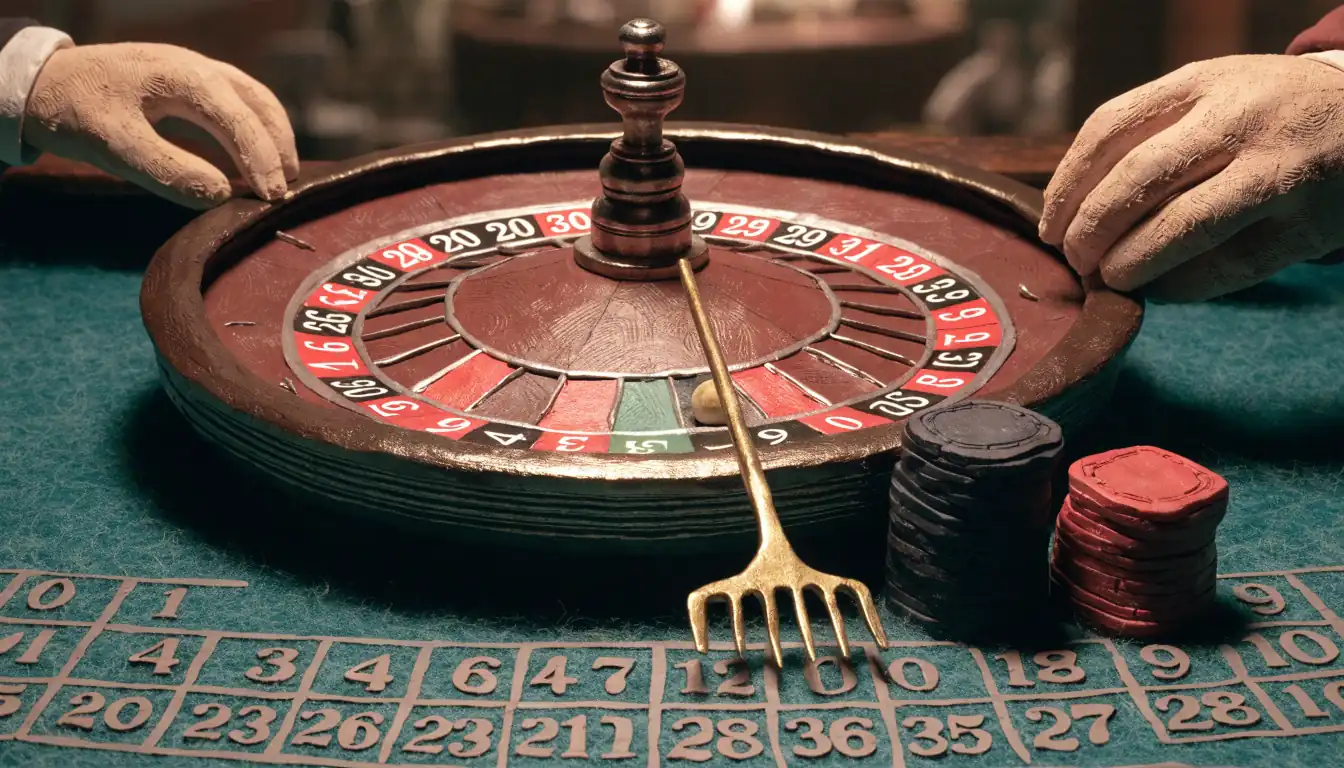
See how the 37-pocket wheel shapes roulette bets, payouts and the differences between online and live play.
How European Roulette Works: One Zero, 37 Pockets
European roulette is built around a wheel containing thirty-seven pockets: the numbers 1 through 36 and one green zero. That single extra pocket is the feature that defines the format. It affects the probability of every result and gives European roulette a lower house edge than the American version.
The wheel is divided into numbered compartments arranged around its rim. A croupier spins the wheel in one direction and sends a small ball around the track in the opposite direction. As the wheel slows, the ball drops through deflectors before settling into one pocket. Online casino European roulette reproduces the same basic event with software rather than a physical wheel, but the outcome still resolves to one of the same thirty-seven pockets when the game follows the standard European format.
The numbers are not simply placed in ascending order. Their contrasting colours and alternating high and low values help create the familiar visual pattern, but the result of a spin is not influenced by the previous pocket or by how the wheel appeared to behave earlier. A run of red results does not make black more likely on the next spin. Each spin is a separate event.
What the single zero changes
The zero is neither red nor black. It is also outside the usual even/odd and low/high groupings. That matters because it gives the casino a result that defeats many of the broadest betting categories. A wager on red loses when the ball lands on zero; the same applies to black, even, odd, low and high selections.
This is the point often softened by the word “balanced”. The red and black sections may look balanced across the numbered pockets, but the complete wheel has thirty-seven outcomes, not thirty-six. There are eighteen red numbers and eighteen black numbers, plus the green zero. A one-unit stake on red therefore has eighteen winning pockets and nineteen losing pockets. The reverse is true for black.
The effect is expressed through the house edge: standard European roulette has a house edge of 2.70%. In practical terms, that percentage describes the mathematical advantage built into the game over a large number of spins. It does not mean that every short session loses 2.70%, nor does it predict the result of an individual spin. A player can win or lose in the very next round; the edge becomes meaningful through repeated play.

That distinction is important in any European roulette casino, whether the game is presented through an automated interface, a live studio or another online format. The display may change, but the single-zero mathematics remains the same unless the table rules specifically say otherwise.
Why European roulette is not American roulette
American roulette adds a second green pocket marked 00. Its wheel has thirty-eight pockets: 1 to 36, zero and double zero. The additional pocket creates another outcome that does not belong to red or black, even or odd, or the high and low groups. As a result, the standard American version has a house edge of 5.26%, compared with 2.70% for European roulette.
The difference is not cosmetic. Both versions use numbers from 1 to 36 and offer familiar coloured and grouped betting areas, but the extra green compartment changes the probability calculation for every standard wager. When comparing a European roulette online casino with an American game, the number of green pockets is one of the first details worth identifying.
Some American tables may also show a third green pocket marked 000. A specialist review has reported this format with a 7.69% house edge, but that should be treated as a particular table description rather than a settled feature of the market. The central comparison remains straightforward: one zero on the European wheel, two on the standard American wheel.
The wheel as a random process
Roulette equipment is designed to make the landing pocket unpredictable. In a physical game, the croupier does not select the number; the wheel, ball and release produce the result. In an online European roulette casino, a random number generator is used to create the simulated outcome. Either way, the relevant question is not whether a sequence “looks due”, but which pockets belong to the chosen format and what the published rules do with the result.
I have seen the same mistake made in both shop-floor conversations and online play: a losing colour is treated as overdue, while a winning number is treated as temporarily unavailable. Neither interpretation changes the wheel. Chance has no memory.
The single zero is therefore more than a green space in the centre of the layout. It is the reason the European game carries a 2.70% house edge, the reason even-money selections can lose on a zero, and the clearest way to distinguish this format from American roulette. Everything else begins with identifying those thirty-seven pockets correctly.
The European Roulette Table, From Wheel to Betting Grid
A European roulette table is easier to read once the two surfaces are treated as one design. The wheel supplies the pockets; the felt, or its digital equivalent, gives each pocket a place where chips can be assigned. The table is not a second random mechanism. It is the betting interface built around the wheel’s numbered outcomes.
The wheel has 37 pockets: the numbers 1 to 36 and one zero. On a physical casino table, the wheel sits beside the dealer’s working area, while the betting layout occupies the broad section in front of the players. Online, the same relationship is recreated on screen. A rendered or streamed wheel appears beside, above, or behind the betting grid, depending on the game interface.
Reading the layout
The central grid normally presents the numbers in three vertical columns, with each column containing twelve numbers. A separate zero space sits at one end of the numbered field. This arrangement lets the layout reflect the wheel’s basic outcome set without attempting to copy the wheel’s circular order.
Around the numbered grid are broader betting areas. These are visually distinct from the individual-number boxes and group outcomes by colour, parity, or numerical range. At this stage, the important point is recognition: the small numbered squares refer to individual pockets, while the larger surrounding sections refer to collections of results.
The wheel itself follows a different visual logic. Its pockets are arranged around a circle, with red and black numbers alternating in an established sequence and the green zero standing apart from both colours. The betting grid places numbers in a mathematical table instead. That difference can feel confusing on a first visit, but it is deliberate: the wheel shows where the ball lands, and the layout shows where chips may be placed.
Physical and digital tables
On a live European roulette casino table, chips are placed directly on the marked areas and the dealer clears them after the result is settled. A digital table replaces physical chips with selectable tokens and clickable betting zones. A live-streamed interface may show both the real wheel and an electronic version of the grid, while an RNG game may use animation for the wheel and ball and keep the grid permanently available.
The same orientation helps when comparing tables across operators. The labels, colours, and position of the zero may vary slightly in presentation, but the relationship remains stable: wheel above, grid below; individual numbers in the centre; grouped areas around them. A supposed roulette strategy does not change that structure. It only changes how someone chooses to use the available spaces.
Single-Zero Roulette Bets and What They Pay
On a European single-zero table, wagers fall into two practical groups: inside bets placed on individual numbers or small number combinations, and outside bets covering broader sections of the layout. The return is fixed by the bet type, not by whether the wheel is physical or simulated. The single green zero is the important exception to the apparent simplicity of even-money bets.
European roulette inside bets
Inside bets sit on the numbered grid. They cover a narrow selection of pockets, so the potential payout is higher but the winning result is less frequent.
A straight-up bet covers one number. If the ball lands on that number, the payout is 35:1. The original stake is normally returned as well, so a winning stake produces the stated profit plus the stake. This payout applies to a single number on both European and American roulette; the difference between the variants comes from the number of pockets against which that return is set.
A split bet covers two adjacent numbers, using the line between them on the table. It pays 17:1 when either covered number wins. The layout matters here: a split is available only where the relevant numbers touch in the grid, rather than between arbitrary numbers chosen from the wheel.
Other inside options cover larger connected groups. A street bet uses a horizontal row of three numbers and pays 11:1. Corner and line bets are also built from adjoining positions on the printed grid, although their exact returns should be checked in the table’s rules before placing them. The underlying principle remains consistent: more covered numbers mean a lower payout, while a narrower selection carries a higher return.
The grid and the wheel do not have the same visual order. A number that is next to another on the betting layout is not necessarily next to it on the single-zero wheel. That distinction matters when describing an inside bet: “adjacent” refers to the marked betting area unless the wager is explicitly defined by wheel sectors.
European roulette outside bets
Outside bets cover groups rather than individual grid positions. Red or black, odd or even, and low or high-number groups all pay 1:1. A winning stake therefore returns an equal profit, subject to the table’s settlement rules.
These bets look close to a fifty-fifty proposition, but zero is neither red nor black, neither odd nor even, and neither low nor high. When the ball lands there, a standard even-money wager loses rather than winning. On a European wheel with 37 pockets, that single excluded result is what gives the game its standard 2.70% house edge.
Some tables apply La Partage to even-money wagers. Under that rule, a zero result returns half of the stake instead of taking the entire bet. For those specific bets, the house edge falls to 1.35%. La Partage does not change the payout on a straight-up, split, or street bet; its effect is limited to the eligible even-money categories.
The useful distinction is therefore mechanical, not strategic. Inside bets trade coverage for a larger stated return, while outside bets cover wider groups at lower odds. Zero remains part of every calculation. That is the price of the single-zero format.
Playing European Roulette Online: Demo, Stakes and Pace
Playing European roulette online is generally a choice between an RNG table and a free demonstration mode. Both use the same basic betting interface: chips are placed on the digital layout, bets are confirmed before the betting period closes, and the result appears after the simulated spin. The important difference is what happens to the balance. Demo play uses virtual credits, while real-money play settles wins and losses against the gambling account.
Free play and real-money roulette
The demonstration version is useful for learning the sequence without putting funds at risk. It shows where to select a number, how to remove or repeat a chip, and how the table displays the result. It also gives a practical feel for the pace of an RNG game. No withdrawal is possible because the balance is only a display value.
Real-money European roulette works in the same visual way, but every confirmed stake affects the account. The relevant terms are not hidden in the wheel: they are the table limits, the available balance and the published payout schedule. European roulette payouts depend on the type of bet placed, not on whether the game is free or paid. A winning straight-up number, for instance, is settled according to the table’s stated odds in either mode.
I have seen players treat demo credits as if they were a small bankroll. That is where the comparison breaks down. Virtual credits do not create financial exposure, and a losing sequence in free play does not reduce the funds available for another session.
How an RNG spin is produced
An RNG game does not use a physical wheel. Software selects the outcome through a random number generator, then presents the corresponding number and colour on screen. The animation may resemble a real ball drop, but it is a representation of the result rather than a recording of a wheel in a studio.
This format normally allows quicker repetition than a dealer-led table. There is no dealing interval, camera feed or physical reset between rounds. RNG roulette also tends to support lower entry stakes; UK games can offer minimum bets as low as 10p. That makes the format suitable for testing the interface or keeping individual wagers small, although a faster cycle can also make it easier to place bets without pausing.

Stakes and pace in practice
Minimums vary by format. A specialist review of UK roulette products reports live tables starting at 10p, while auto-roulette and speed formats can begin at 5p. Those figures describe possible starting points, not a universal rule for every table. A premium or VIP table may set a higher minimum, while an automatic table removes the dealer interaction without necessarily changing the underlying single-zero rules.
The pace deserves equal attention. Faster software rounds mean that more decisions can be made in less time. The odds do not improve with speed, and previous results do not influence the next RNG selection. No betting method can forecast the final outcome: roulette remains governed by chance, whether the stake is virtual, 10p, or higher.
A sensible comparison between free and real-money play therefore has three parts: the same bet mechanics, a different consequence for the balance, and a different level of urgency created by the format. The screen can look identical. The exposure is not.
Roulette Systems: Why a Losing Run Still Matters
The Martingale is attractive because its instruction is simple: place an even-money bet, then double the stake after every loss. A win is intended to recover the earlier losing bets and leave a profit equal to the original stake. On paper, the sequence looks orderly. At a real table, the exposure grows faster than the logic suggests.
The system does not alter the roulette wheel, the available bets or the underlying probability of the next spin. Each result remains independent. A run of black outcomes does not make red “due”, and several losses do not improve the chance that the next even-money wager will succeed. I have seen the mistake made in both directions: treating a pattern as a signal, or treating a betting progression as if it changed the game.
What doubling actually does
Suppose the opening stake is one unit. After a loss, the next stake becomes two units; after another loss, it becomes four, then eight. The individual bet is getting larger precisely while the bankroll is shrinking. If the sequence continues, the amount needed for the next wager may be unavailable, or it may exceed the table’s permitted stake.
The important figure is not only the next stake. It is the accumulated loss. Before the next wager begins, every failed step has already reduced the funds available for continuation. A later win may recover earlier losses only if the required larger stake can still be placed and the table accepts it. If either condition fails, the intended progression stops at the point where the financial pressure is greatest.
That is the central weakness of the Martingale: it exchanges many small apparent successes for the possibility of one damaging losing run. A session can show repeated recoveries and still finish badly when the sequence meets a sufficiently long series of losses. The system has no mechanism for making that series less likely.
Why a “safe” bet is not safe
Martingale is most often attached to red or black, odd or even, or high or low. These are commonly described as even-money bets because a winning stake returns an equal amount in profit. That label does not mean that a win is guaranteed to occur within a chosen number of spins. The zero remains a losing result for ordinary even-money bets, so the bet is not a simple two-outcome promise.
This matters when a progression is presented as “low risk”. The bet may cover many numbered outcomes, but it does not cover every pocket. More importantly, the system depends on the next result arriving at the right time. Chance decides whether that happens; the previous sequence cannot force it.
My own rule when reviewing a betting claim is to separate the wager from the staking pattern. The wager has fixed odds. The progression only changes how much money is exposed to those odds.
Bankroll damage is the practical risk
A losing streak can harm a bankroll before any theoretical recovery is possible. The damage may come from continuing to chase the sequence, increasing stakes beyond the original plan, or using funds intended for something else. A player can also stop after a loss and retain the deficit; stopping does not turn the progression into a completed recovery.
This is why “best” European roulette tables, free online demonstrations and real-money games should not be treated as evidence for a winning system. Free play can show how a progression is entered, but it cannot demonstrate that doubling predicts results or protects money. A roulette-themed slot is a different product again, not proof of a table-game strategy.
The disciplined interpretation
European roulette rules determine the pockets and payouts; they do not contain a rule that rewards doubling after a loss. No roulette strategy can predict the final outcome, because the odds are governed by chance. Martingale can organise a sequence of stakes, but it cannot organise the spins themselves.
The blunt version: bigger bets, same odds.
Finding a UK Casino That Offers European Roulette
Searching for European roulette casinos in the UK is less about finding a colourful lobby and more about checking what sits behind the game tile. A casino may advertise roulette broadly while offering several formats: single-zero European roulette, American roulette, live tables, automated wheels, or roulette-themed slots. Those are different products. The useful check is whether the rules, wheel type and delivery format are clearly identified before an account is funded.
- Confirm it is single-zero European roulette
- Verify the wheel type (RNG, automated, or live)
- Check the available payouts and RTP
- Identify the minimum and maximum stakes
- Ensure the operator has a valid UKGC licence
I have found that the word “European” is sometimes used loosely in menus. The decisive detail is the wheel: European roulette has one zero, whereas American roulette includes an additional zero. The game information should also show the available bets, payouts and return-to-player information. RTP is the practical figure to look for when comparing UKGC-licensed operators, because it expresses the theoretical return of the game rather than relying on labels such as “premium” or “VIP”.
Confirm the UKGC licence first
For British players, the operator’s regulatory status comes before the game catalogue. The UK Gambling Commission is the sole regulator of online casino activity in Great Britain. A remote operator selling gambling to customers there must hold the appropriate Gambling Commission licence, even when the business itself is based elsewhere.
The licence number should be checked on the UKGC public register rather than accepted from a badge in the casino footer. The register confirms whether the licence is current and whether it belongs to the business operating the site. This matters because an offshore casino may remain accessible from Britain without being part of the UKGC system. It cannot legally offer real-money live roulette to British residents without a valid UKGC licence.
That distinction is easy to miss when a site displays familiar payment logos or uses British currency. Accessibility is not the same as authorisation.
Check the game details, not the banner
Once the licence has been verified, the roulette lobby needs a closer inspection. A suitable listing should identify:
- European or single-zero roulette, rather than simply “roulette”;
- whether the wheel is RNG, automated or live dealer;
- the RTP or equivalent game information;
- the minimum and maximum stakes shown in the table rules;
- the provider responsible for the game;
- any special rules that alter standard payouts.
The last point is important for branded or feature-led games. A title containing “Lightning”, “VIP” or another promotional term may not use ordinary European roulette payouts. The rules panel is more reliable than the thumbnail. If the game page does not explain the wheel, paytable and RTP clearly, the omission is itself a reason to leave the title unselected.
Roulette-themed slots should also be kept separate from table games. A slot can borrow the language and imagery of roulette while using reels, paylines and slot-specific rules. It does not demonstrate that the casino offers European roulette.
Responsible-gambling checks are part of the assessment
A UKGC-licensed casino must provide more than access to a game. Before the first deposit, a new customer must be prompted to set a financial limit, with account-level controls available afterwards. Licensed live-casino operators must also offer deposit limits, loss limits, session-time reminders, reality checks, cool-off periods and GamStop self-exclusion.
Age verification comes before depositing funds. The operator must establish that the customer is old enough to gamble before allowing money to be placed into the account. In the UK, online gambling is legal for players aged eighteen and over where the operator holds a UK Gambling Commission licence.
Payment controls reveal the same regulatory framework. UKGC-licensed casinos cannot accept credit cards for gambling, including credit-card funding routed through a money service business. A wallet cannot be used for gambling either when it permits credit-card funds to be used for that purpose. These are not minor checkout preferences; they are part of the conditions under which the operator may serve the British market.
Read bonus terms before attaching roulette
Promotional wording can make a roulette offer sound more generous than its mechanics. The relevant detail is game weighting: how much a roulette wager counts towards the stated wagering requirement. Roulette may receive a lower weighting than some other casino games, while the precise treatment varies between operators and between RNG and live formats.
Since January 2026, licensed operators in the UK have been subject to a ceiling of ten times the bonus amount for wagering requirements. That cap does not make every promotion equally suitable. A bonus can still restrict eligible games, apply different weighting to live roulette, impose expiry conditions, or exclude certain bets. The terms determine whether European roulette qualifies and how its wagers are counted.
UKGC licensees must also provide an internal complaints procedure and access to an approved Alternative Dispute Resolution service. If a dispute arises over a missing game, a settlement or a promotion, those routes provide a defined escalation path.
In practice, the strongest shortlist is not the one with the loudest “best European roulette” claim. It is the group of UKGC-licensed operators whose register entry, game rules, RTP information, responsible-gambling controls and bonus wording all withstand a careful check. That is the useful filter.
Roulette Wheels in RNG, Speed and Live Formats
The word “wheel” covers different delivery methods in an online casino. In one game, the European roulette wheel is a software representation of a single-zero wheel with 37 pockets. In another, a camera shows a physical wheel turning in a studio. The betting rules may look familiar in both, but the source of each spin and the pace of play are different.

RNG roulette: a simulated wheel
RNG roulette uses a random number generator rather than a physical ball and wheel. The software determines the result, then displays it through a visual wheel, animation or numbered result screen. The picture is part of the interface; it is not evidence that a mechanical wheel has been spun.
That distinction matters mainly for presentation and speed, not for the basic identity of the game. Where the layout is European roulette, the displayed wheel should represent the single green zero and numbers 1 to 36. The key point is to check the game rules and variant label rather than judge the format by its graphics.
RNG games are built for quick repetition. They generally support lower minimum stakes, with some UK versions starting at 10p. This makes them suitable for short sessions or smaller individual bets, while the rapid cycle can also make a balance move more quickly than expected.
Speed and auto-roulette
Speed roulette sits between a conventional interface and a high-frequency format. The result may come from an automated physical wheel or a similarly streamlined game presentation, depending on the operator and provider. Its defining feature is the reduced time between rounds.
A specialist review gives speed roulette a rate of more than 150 spins per hour, compared with 80–100 spins per hour for a standard table. Those figures describe the format rather than a guaranteed experience: betting windows, pauses and settlement screens still affect the actual rhythm.
Auto-roulette can also lower the entry point. A UK table minimum may start at 10p for live roulette, whereas auto-roulette and speed formats sometimes begin at 5p. A lower minimum does not change the probability of a result. It only changes how much can be placed on each round.
RNG Roulette
A software representation of a single-zero wheel using a random number generator.
Speed Roulette
A streamlined format with a reduced time between rounds.
Live Roulette
A streamed physical wheel with a human dealer.
Live roulette: a physical wheel on screen
Live dealer roulette streams a real studio wheel, with a human dealer and an actual ball drop. Here, the European roulette casino wheel is not merely an animation: the camera shows the equipment used for the spin, while the interface records the selected bets and displays the outcome.
The format is slower because the wheel must be spun, the ball must settle and the dealer must manage the table. It also makes the physical green zero visible when the game is a European single-zero table. That visual detail is useful, but the game’s rules panel remains the reliable place to confirm the variant.
So “wheel” can mean a simulated display, an automated physical mechanism or a streamed studio wheel. The number of pockets and the green zero identify the European format; the delivery method determines how the spin is produced and how quickly the next betting window arrives.
Demo Roulette Slots: A Different Product from the Table Game
A roulette-themed slot may look familiar without being roulette. The reels, symbols and bonus animations borrow the visual language of the wheel, but the result is produced as a slot spin rather than a ball landing in one of the European wheel’s pockets. That difference affects the rules, the interface and the way any return is calculated.
Searches for a three-dimensional European roulette slot, or titles described as European Roulette Gold and European Roulette Platinum, can therefore lead to products that resemble a casino table but do not reproduce its betting layout. A conventional European roulette game has a wheel, a single zero and selectable wagers placed on numbered or grouped outcomes. A roulette slot has reels, paylines or feature mechanics defined by its own game design. The title is not enough to identify the product.

What the demo version actually does
A European roulette demo may refer to a free-play table game, while a European roulette slot demo normally opens the slot without real-money wagering. In both cases, the balance shown on screen is for testing the interface rather than funding withdrawals. It allows the game flow, buttons and animations to be inspected, but it does not turn a slot into a roulette table.
The distinction matters because demo play removes the financial consequence of each result. A player can practise selecting a stake or explore a bonus feature, yet no real account balance is placed at risk and no bonus wagering is generated merely by opening the demonstration. Once real-money play is selected, the operator’s account rules, age verification and payment controls apply.
From my side of the counter, the most common misunderstanding was treating the word “roulette” in a slot title as a statement about the underlying mathematics. It is usually branding. The reels decide.
Checking the product before playing
The information panel should identify whether the game is a table game or a slot and explain its specific rules. A title containing “gold”, “platinum” or “3D” describes presentation or branding, not proof of European roulette mechanics. The same caution applies to a page labelled as a roulette slot demo: the free mode demonstrates that particular slot, not the operation of a physical wheel.
For a real-money slot in Britain, the wider UK rules remain relevant. Autoplay is banned for online slots, and each spin must last at least 2.5 seconds. A roulette-themed slot is still a slot for these purposes, regardless of its graphics. Credit cards cannot be used for gambling, including through a payment wallet funded by credit. The label may be decorative; the regulatory category is not.
Live European Roulette: Dealers, Limits and Bonus Terms
Live European roulette replaces the software interface with a streamed table. A studio camera shows a physical wheel, a real ball drop and a human dealer managing the round. Bets are placed through the on-screen layout before betting closes; the result then comes from that displayed wheel rather than a purely simulated presentation. From the industry side, that distinction matters because the appeal is as much about visible procedure as the single-zero game itself.
A live-dealer table also carries account controls that are easy to overlook beside the video feed. UKGC-licensed live casino operators must provide deposit limits, loss limits, session-time reminders and reality checks. They must also make cool-off periods and GamStop self-exclusion available. These are account-level tools, not features added by the dealer during a spin. New customers must be prompted to set a financial limit before making a first deposit, while accessible controls must remain available afterwards.
Age verification comes before depositing funds. A platform without a valid UK Gambling Commission licence cannot legally offer real-money live roulette to British residents. The licence number should be checked on the UKGC public register before any deposit is made. UKGC licensees must also provide an internal complaints route and access to an approved Alternative Dispute Resolution service.
The other condition is hidden in bonus wording. Roulette often receives game weighting rather than full credit towards a promotion’s wagering requirement. Most operators count roulette stakes at 10% to 20%, meaning a qualifying stake contributes only a fraction of its face value. Live roulette can therefore be materially less useful for clearing bonus funds than an eligible game with full weighting.
No-deposit offers can be tighter still. A specialist review reports that some UK operators exclude live roulette entirely from those requirements; where it is included, the stated weighting is 0–10%. That is not a universal rule, so the promotion’s own table of game contributions controls the outcome. A live table may be open, the bet may settle normally, and the wagering meter may barely move. Read the weighting first.
European vs American Roulette: The Extra Zero Changes the Edge
The central difference in European roulette vs American roulette is the number of pockets on the wheel. European roulette has 37: numbers 1 to 36 and one green zero. American roulette adds a second green pocket, marked 00, bringing the total to 38.
That extra pocket is not decorative. It changes the probability of every winning number and therefore the mathematical advantage retained by the house.
| Variant | Pockets | House edge |
|---|---|---|
| European roulette | 37 | 2.70% |
| American roulette | 38 | 5.26% |
On a standard single-number bet, both versions pay 35:1. The payout looks identical, but the wheel has a different denominator. In the European game, the winning number is one of 37 possible results; in the American game, it is one of 38. The stated payout therefore returns less relative value in the American version, even though the bet slip appears familiar.
That distinction matters when comparing an online European roulette casino game with an American table presented in the same lobby. The interface may use the same colours, chip controls and betting labels, but the extra zero remains part of the underlying mathematics. A polished design does not make the variants equivalent.
Some specialist reviews also describe American tables with a third green pocket labelled 000, producing a stated house edge of 7.69%. That is a particular format reported by that type of source, not a general description of American roulette.
European roulette is consequently the lower-edge choice of the two standard versions. It does not turn a casino game into a predictable one, and it does not alter the fact that each spin is independent. Its advantage is narrower and more precise: one green pocket instead of two. On a real-money or online European roulette casino game, that is the defining structural difference.
Is live dealer roulette fair?
Live roulette uses a real wheel, a human dealer and a physical ball drop. Roulette outcomes are determined by chance, and a losing or winning streak does not affect the next spin.
What does online casino roulette for real money mean?
It means placing roulette bets using money rather than playing only for free. In standard European roulette, the wheel has 37 pockets and a 2.70% house edge.
How does roulette actually work?
A wheel spins while a ball travels in the opposite direction, then the ball settles into a numbered pocket. In European roulette there are 1–36 and a single zero; online RNG games simulate the outcome with a random number generator.
What are inside and outside roulette wagers?
Inside bets select specific numbers or small groups of numbers, such as a single-number bet, which pays 35:1 in standard roulette. Outside bets cover broader groups such as red or black, even or odd, and high or low; these pay 1:1.
What makes XXXtreme Lightning Roulette different from regular roulette?
Lightning Roulette changes the payout for a straight-up number bet: without a lightning multiplier, it pays 29:1 rather than the standard 35:1. Outside bets keep standard roulette payouts.
Casino Games: Slots, Table Games and Live Play
Created by the "Casinoexitgamstop.com" editorial team.