
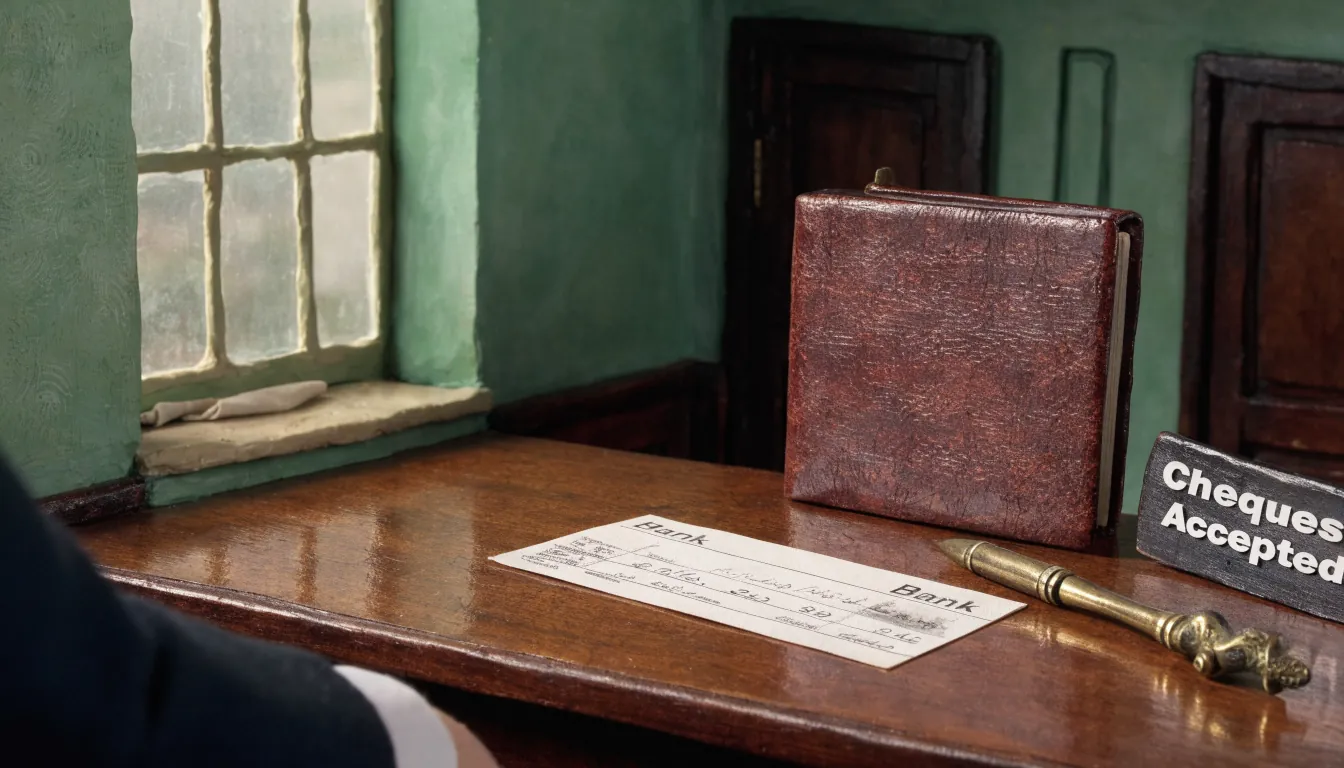
Bank cheques and Pay by Phone use different payment systems, and a mobile deposit does not establish that a casino accepts cheques.
Why Cheque Casinos Are Hard to Find in the UK
A bank cheque and a Pay by Phone deposit belong to different payment systems. A bank cheque is drawn through a bank and normally requires the receiving business to handle, verify and clear the instrument. Pay by Phone works through a mobile network account instead. The charge is attached to the phone bill or taken from prepaid credit.
That distinction matters because casino payment pages and promotional descriptions can place several older and newer methods under broad headings such as “alternative payments”. The label may suggest that a casino accepts many forms of non-card funding, while the actual cashier supports only a particular mobile service. “Alternative” describes the position in the menu, not the underlying payment mechanism.
From the operator’s side, a cheque also creates an awkward settlement process. The casino would need to receive the instrument, confirm that it is genuine, wait for the banking process, and associate the cleared funds with the correct gambling account. A digital cashier method is easier to connect to account verification and deposit records. That difference helps explain why a request for casinos accepting bank cheques can lead to information about Pay by Phone services instead.
Why old payment references cause confusion
Payment pages do not remain fixed. Operators add and remove methods, payment providers change their coverage, and an article can continue circulating after the cashier has changed. A reference to a mobile deposit service may therefore be mistaken for evidence that the casino accepts cheques, particularly when both are discussed as ways to fund an account without using a conventional bank card.
The wording also matters. “Phone bill deposit”, “mobile payment” and “Pay by Phone” describe a charge made through a mobile network. None of those terms means that a bank cheque can be posted, uploaded or entered in the cashier. A casino may support a phone-based charge and still have no process for receiving a cheque.
I have seen this distinction get lost at the point where a payment method is reduced to a short cashier label. The label looks simple; the settlement route is not. That is where the mistaken equivalence starts.

The UK market has moved away from Boku
A small group of casinos holding UK Gambling Commission licences still accepts Boku deposits, but the available set has been contracting since 2023. This is relevant to cheque-related research because Boku is one of the payment names most likely to appear when a casino is described as accepting deposits without a card or bank account. Its presence indicates a mobile billing route, not a bank-cheque facility.
A specialist review has reported that operators have shifted from Boku towards Fonix and Siru Mobile, while some have removed Pay by Phone choices altogether. That movement makes static lists particularly unreliable. A casino named in an older payment guide may no longer display the same option, and a replacement service may be presented as though it were simply another form of cheque funding.
The change is not a conversion of cheques into mobile payments. It is a change within the Pay by Phone market. Boku, Fonix and Siru Mobile are separate payment brands and use mobile-network billing arrangements. A bank cheque remains a different category of instrument.

What a cheque claim would need to establish
A credible claim that a UK online casino accepts bank cheques would need to identify an actual cheque procedure: how the cheque is submitted, whose name receives it, how clearance is confirmed, and when the deposit becomes available in the gambling account. A reference only to Boku, Fonix, Siru Mobile or another mobile option does not establish any of those points.
The same applies to descriptions using phrases such as “cashier alternatives” or “bank-free deposits”. Those descriptions may accurately refer to a phone account being charged, but they do not establish that the operator handles bank cheques. Treating them as interchangeable can lead to a failed deposit attempt or, worse, money being sent through a route that was never intended for that purpose.
The practical reading is therefore narrow. Information about Pay by Phone services can explain how certain casinos accept mobile-funded deposits and why the remaining market is limited. It cannot turn those services into cheque deposits, and it cannot support a ranking of the best or top UK casinos for bank-cheque payments.
“Same purpose” is not the same method.
What the UK Licence Does—and Does Not—Tell Players
The UK Gambling Commission is the regulator behind commercial gambling in Great Britain, including online casino activity. Its remit covers remote gambling offered to consumers in Great Britain even when the operator’s key equipment is located elsewhere. That point matters because the physical location of a company, server or payment department does not decide whether a British-facing casino needs local authorisation.
For commercial gambling in Great Britain, the Gambling Commission is the sole regulator. It issues operating licences to businesses and personal licences to individuals involved in operating gambling services. An operating licence therefore concerns the company providing the gambling service; a personal licence concerns certain people whose roles require individual approval.
That regulatory boundary is more useful than a payment badge. A cashier may display a method associated with mobile billing, cards or e-wallets, but the presence of a familiar payment name does not establish that the casino is authorised to offer gambling in Great Britain. Payment availability and gambling permission are separate questions.

What a current operating licence establishes
A current Gambling Commission operating licence indicates that the business has the relevant authorisation to provide its licensed gambling service to consumers in Great Britain. It is the basic status check before an account is funded. The licence is not a guarantee that every advertised payment route remains available, that a particular deposit will qualify for a promotion, or that a requested transaction will be accepted without additional checks.
In practical terms, the licence check answers a narrow but important question: is this operator permitted to serve the British market under the Gambling Commission’s framework? It does not turn an unverified claim about bank-cheque deposits into an established feature. Nor does a reference to a UK-facing website, a British currency balance or a familiar brand name replace the licence check.
I have seen payment pages create confusion by placing several methods under one broad heading. That presentation can make a casino appear more established than the underlying terms justify. The safer reading is administrative rather than promotional: identify the operating company, find its entry on the Gambling Commission’s public register, and confirm that the status is current before depositing.

The licence does not approve every cashier claim
A Gambling Commission licence is not a certificate for every product description or payment statement appearing on a casino website. It authorises the operator’s regulated gambling activity within the applicable scope. The cashier still has its own conditions, and those conditions may vary by account, payment provider and operator.
This distinction is especially important for searches about casinos accepting bank cheques in the UK. A casino can be licensed while a cheque route is unavailable, unsupported or subject to terms that do not match the wording used in an advert. Conversely, a payment provider’s appearance in a cashier does not demonstrate that the casino accepts bank-cheque deposits. The two checks should never be merged.
The licence also does not remove the need for account controls. Before allowing deposits, operators must verify a customer’s age. Remote operators must prompt new customers to set a financial limit before the first deposit and provide accessible controls for account-level limits. These are account safeguards attached to the regulated service, not evidence that a particular funding method is supported.
Other protections sit around the same framework. UK-licensed casinos must provide responsible-gambling tools, including self-exclusion, and must maintain an internal complaints process with access to an approved Alternative Dispute Resolution service. Those arrangements matter when an account, transaction or gambling service becomes disputed, but they do not promise a particular result in a payment enquiry.
The useful conclusion at this stage is deliberately limited. A licence confirms the operator’s regulatory standing in Great Britain; it does not confirm that the cashier accepts bank cheques, that a payment option is available to every customer, or that the method’s terms suit a planned deposit. Those details must be checked separately, after the operator’s identity and licence status have been established.
First, the licence. Then the cashier.

The Payment Route the Evidence Actually Supports
A bank cheque and a Pay by Phone deposit belong to different payment systems. A cheque is a paper instruction connected with a bank account. Pay by Phone uses a mobile number and charges the transaction to the account held with a network provider. Treating the two as interchangeable changes the meaning of the payment condition.
That distinction matters because casino payment pages and promotional descriptions sometimes group several non-card methods under broad labels such as “alternative payments”. The label sounds inclusive; the underlying route may be narrow. Boku does not receive, clear or convert a bank cheque. It bills the mobile connection used for the transaction.
What Boku actually does
Boku acts as a carrier-billed payment method. The casino requests a payment through Boku, and the charge is passed to the player’s mobile network operator. For a contract customer, that normally means the amount appears on the monthly mobile bill. For a PAYG customer, it is deducted from the available prepaid balance.
That is the operational difference from a bank-cheque deposit. No cheque is posted to the casino, deposited with a bank, or held while funds clear. The payment depends on an active mobile account and the network’s ability to approve the charge. Boku therefore sits closer to a phone-bill purchase than to a bank transfer or a traditional cheque transaction.
The mechanism also explains why the service can be used without entering card details or bank-account information. The mobile number identifies the billing route, while the network relationship supplies the payment source. “No card required” is not another name for cheque acceptance. It describes how the mobile account is charged.
Other Pay by Phone branding
The same general principle applies to other Pay by Phone providers. Fonix is another mobile-payment route rather than a bank instrument. Pay by Phone and Fonix are supported by EE, O2, Vodafone and Three, although support by a network does not by itself establish that every casino offers the method or that every customer account can use it.
Boku
A carrier-billed method where charges appear on a monthly mobile bill or are deducted from prepaid credit.
Fonix
A mobile-payment route supported by major UK networks.
Siru Mobile
A mobile-billing arrangement used by some operators as an alternative to Boku.
This is where cashier terminology needs careful reading. A page may show Boku, Fonix or another mobile-payment logo beside cards, bank transfers and e-wallets. Those options may look like variations of one funding category, but each has its own processing arrangement. A mobile method uses the phone account; a cheque would require the operator to accept and process a banking document. One logo cannot stand in for the other.
I have seen this confusion arise when a site describes “banking alternatives” in a single paragraph. The wording is commercially tidy but technically unhelpful. A customer looking for a casino that accepts bank cheques could reasonably assume that a mobile-payment logo indicates some form of bank-backed payment. It does not.
Reading the cashier without guessing
The reliable distinction is the payment source named in the instructions:
- A Boku entry refers to a mobile number, network billing or Pay by Phone.
- A PAYG description refers to prepaid mobile credit being reduced.
- A contract-phone description refers to the monthly bill.
- A cheque instruction would need to state how the cheque is made payable, where it is sent and when the casino treats it as cleared.
Only the first three descriptions belong to the documented Boku route. They describe a charge against a phone account, not a deposit made with a bank cheque. The wording “mobile payment” should therefore be read literally.
This also applies when a casino advertises a route as “simple” or “instant”. Those words refer to the payment experience being described, not to a different funding source hidden behind it. A mobile charge may be approved through the network; that does not make it a cleared cheque.
The practical conclusion within this payment distinction is limited but important: Boku and comparable Pay by Phone services explain a documented way to fund some casino accounts, while they do not substantiate claims about online casinos accepting bank-cheque payments. Different instruments, different processing chain. No shortcut.
How a Boku Deposit Is Made—and Why It Is Deposit-Only
Boku is used from the casino’s cashier rather than from a bank account. The transaction starts after the gambling account has been opened and the payment page has loaded. Boku is selected from the available deposit methods, alongside whatever other options that operator supports.
The cashier then asks for the intended deposit amount and the mobile number connected to the payment. That number is not a contact detail added for convenience; it identifies the mobile account that will be charged. A wrong number can send the authorisation request to the wrong place or prevent the payment from being completed.
The basic sequence is:
- Open the casino cashier and choose Boku.
- Enter the deposit amount.
- Provide the relevant mobile phone number.
- Wait for the SMS verification request.
- Enter the verification code to authorise the payment.
The SMS step is the control point. Until the code is entered, the payment has not been confirmed through the Boku route. Once the authorisation succeeds, the deposit is credited to the casino balance according to the operator’s processing flow. In practice, the important distinction is between selecting Boku and approving the charge: choosing the method only begins the transaction.
From the operator’s side, this is a fairly contained payment process. The casino cashier passes the request into the Boku service, while the mobile number and SMS confirmation link the transaction to the phone account. That is why the method works without entering card details into the casino cashier. It does not, however, turn the phone into a bank account or create a route for moving casino winnings back through Boku.
The withdrawal problem
Boku is deposit-only. Money can go into the casino account through the service, but winnings cannot be sent back to Boku. This is the point frequently lost in descriptions that call Pay by Phone “simple” or “direct”. The payment is direct only in one direction.
A withdrawal therefore has to use another method registered with the casino. The account may need a separately recorded debit card, e-wallet or bank-transfer destination, subject to the operator’s verification and withdrawal rules. The Boku payment itself does not provide that destination.
This creates a practical separation between funding and cashing out:
- Boku supplies the deposit channel.
- The casino balance records the funds and any winnings.
- A different, registered payment method handles the withdrawal.
That separation matters when comparing payment claims attached to UK casino sites. A cashier displaying Boku does not mean that the same cashier can return funds to the mobile account. Nor does a mobile deposit establish that the operator accepts bank cheques. It identifies one particular way of funding the gambling account.
I have seen payment pages described as “fully flexible” when the underlying method was restricted to deposits. The wording sounds broad; the transaction design is not. Deposit-only means exactly that.
Before a Boku payment is authorised, the withdrawal route should already be understood. Otherwise the deposit may be easy to make while the later withdrawal requires additional account checks, payment registration or a change of method. The SMS confirmation proves authority to charge the phone account; it does not pre-approve a withdrawal destination.
For anyone comparing online casinos associated with cheque deposits, this operational detail prevents a category mistake. The cashier procedure described here is a mobile-payment workflow: select Boku, enter the amount and phone number, then confirm by SMS. It is not a bank-cheque workflow, and Boku cannot be used to withdraw casino funds.
Limits, Phone-Bill Charging and the Small Print
Boku limits are not a single figure set by the casino. Three separate controls can affect a payment: the amount permitted for one transaction, the total allowed by the mobile network during a day, and the available balance on a prepaid phone.

A specialist review gives £30 as the standard UK Boku transaction limit, while noting that some casinos or network operators may permit £40 or £50. That is not a fixed market rule; the cashier and the mobile provider can apply different ceilings. A separate account of Boku limits describes £30 per day at network level without specifying a per-transaction cap. The disagreement matters because a single-payment limit and a daily allowance restrict different parts of the transaction.
A further version reported in specialist payment coverage puts the network allowance at about £10 per transaction and £30 per day. Since these descriptions do not align, the amount displayed in the cashier should not be treated as proof of the mobile operator’s daily allowance. The operator may accept the request while the network rejects it after its own threshold has been reached.
That daily control sits with the mobile operator rather than the casino, according to a specialist review. The casino can show Boku as an available cashier method, but it does not necessarily control the network’s accumulated daily total. This is why a deposit may fail even when the casino account itself has no matching restriction.
The charging route also determines what remains available. Contract customers have the payment added to the mobile bill. Pay-as-you-go customers have the amount taken from their existing phone credit. Specialist payment coverage states that a PAYG payment cannot exceed the credit left on the account; an insufficient balance results in a declined transaction rather than a partial deposit.
Boku therefore behaves less like a bank transfer and more like a controlled charge against a communications account. The visible casino limit is only one layer of the arrangement. Network rules can narrow it, and PAYG credit can narrow it again.
Small print, not headline limits.
Why the Remaining Boku Market Keeps Changing
Boku availability is not fixed across the UK casino market. Operators can remove it from the cashier, replace it with another Pay by Phone provider, or discontinue mobile payments altogether. That movement can make an old payment list look authoritative when it is no longer describing the same cashier.
The important regulatory point is that the UK Gambling Commission did not introduce a rule specifically banning Boku by name. The change came from operator-level decisions, particularly where businesses judged the compliance risk of a payment route too high. In practice, that produces an uneven market: one licensed casino may retain Boku while another removes it, even though both operate under the same British gambling framework.
I have seen this kind of change create a misleading impression. A page may say that a casino accepts mobile payments, but the label can refer to a newer provider rather than Boku. “Pay by mobile” is therefore a category description, not proof that Boku remains available. The cashier is the operational record.
A specialist casino review identified a shift away from Boku since 2023. In that account, operators replaced it with Fonix or Siru Mobile, while others removed Pay by Phone options entirely. Because the observation comes from a market review rather than a permanent regulatory notice, it should be treated as time-sensitive. Payment menus change when commercial arrangements, risk assessments or internal controls change.
The named examples show why provider and operator must be kept separate:
- MrQ and Duelz were reported as accepting Fonix.
- Mr Vegas and Videoslots were reported as accepting Siru Mobile.
Those examples do not establish that Boku is available at those operators. They show only how a casino can retain a mobile-payment route while changing the company processing it. The distinction matters because each provider has its own transaction process, network arrangements and account conditions.
For anyone comparing casinos that appear suitable for cheque-style funding, this is where assumptions tend to enter. A site listed in an older review may have removed Boku, moved to Fonix or Siru Mobile, or stopped accepting Pay by Phone payments. Conversely, the presence of a mobile-payment logo does not identify the provider currently enabled for a particular account or jurisdiction.
The practical reading is straightforward: operator availability and provider availability are separate checks. A UKGC licence does not itself confirm that Boku is present, and the absence of Boku does not mean that the Commission prohibited it. It reflects a changing commercial and compliance decision by the operator. That distinction is easy to miss.

Pay by Mobile Is Not the Same as Paying by Cheque
The wording around casino payments can make two unrelated methods look interchangeable. They are not. A bank cheque is a paper instrument drawn on a bank account. Pay by Phone is a mobile-billing arrangement: the casino payment is linked to a mobile number, and the charge is passed to the network account or deducted from prepaid credit.
That difference matters when assessing claims about an online casino cheque deposit in the UK. A cashier displaying Boku, Fonix or another mobile-payment brand is not offering a facility for posting, scanning or depositing a bank cheque. The presence of a phone-based option says nothing about whether the operator accepts cheques.
What the mobile route actually uses
Pay by Phone does not require a card or bank account for the casino transaction. The payment is associated with a supported mobile service. Boku can charge a monthly mobile bill or reduce available PAYG credit, while other providers operate through their own mobile-billing arrangements.
The network coverage also belongs to the payment service, not to cheque banking. Pay by Phone and Fonix are supported by EE, O2, Vodafone and Three. That tells the cashier which mobile connections may be eligible; it does not create a bank-cheque channel.

I have seen payment labels treated as broad proof that a casino accepts every non-card method. That is how a convenient alternative becomes a misleading “cheque option”. The label is narrower than the advert suggests.
Different brands, same basic distinction
Operator cashiers may show different mobile providers. A specialist review recorded Fonix at MrQ and Duelz, and Siru Mobile at Mr Vegas and Videoslots. Such listings describe mobile-billing availability at the time of checking. They should not be read as evidence of bank-cheque acceptance, and payment menus can change.
The practical test is the instruction attached to the method. A mobile option asks for a telephone number and uses the mobile network to authorise the charge. A cheque route would require the operator to explain how a bank cheque is submitted, verified and credited. Those are separate processes with separate risks of delay and rejection.
Consequently, a search for an online casino that accepts bank cheque deposits should not be answered with a list of casinos offering Boku, Fonix or Siru Mobile. Those services may provide a way to fund a gambling account from a phone bill or PAYG balance, but they do not turn that balance into a cheque deposit.
The terminology is not cosmetic. It determines which account is charged, which provider controls the transaction and what the casino’s payment terms need to say. Mobile payment is mobile payment. A bank cheque is something else.
Bonus Terms Can Change the Value of a Mobile Deposit
A Pay by Phone deposit and a welcome offer are separate parts of a casino account. The cashier may accept the payment while the promotion rules exclude it. That distinction matters because the advertised value of a deposit can depend less on whether the money arrives than on whether the operator counts it towards the offer.
The treatment is not uniform. A specialist review identified MrQ, Duelz, Mr Vegas and Videoslots as accepting Pay by Phone deposits for bonus eligibility. That is an operator-specific position, not a rule applying across casinos accepting cheques or other payment methods in the UK. Another operator may accept the same payment route but exclude it from a welcome promotion.
Do
- Check the Gambling Commission register for a valid licence
- Confirm if a specific deposit qualifies for a bonus
- Read the exact cashier terms for your chosen method
Don’t
- Assume “alternative payments” includes bank cheques
- Expect to withdraw winnings via Boku
- Treat mobile-billing logos as evidence of cheque acceptance
Boku deposits have generally been presented without a dedicated Boku bonus, while the reviewed platforms did not attach specific Boku deposit restrictions. The wording still needs careful reading: “eligible” can mean that the deposit qualifies for the main offer, not that a separate reward exists for using Boku.
The standard promotional structure seen in UK casino offers is a deposit match of 100% up to £100, with wagering set at 35 times the relevant bonus amount. Those terms create a liability, not free cash. Bonus funds expire after 30 days, and bonus spins expire after 72 hours, according to a specialist review. An operator’s current terms take priority over any description elsewhere.
The practical check is therefore short:
- confirm that Pay by Phone deposits qualify for the specific welcome offer;
- establish whether the wagering requirement applies to the bonus, the deposit, or another defined amount;
- check the expiry period for bonus funds or spins;
- look for restrictions on games, withdrawals and qualifying deposits.
A payment method can be accepted at the cashier and still be a poor route for a promotion. The two decisions are separate.
Funding an E-Wallet Is a Separate Route, Not a Cheque Deposit
A Boku-to-Neteller route changes where the payment is made. It does not create a bank-cheque facility at an online casino.
The documented arrangement is indirect: Boku is used to add funds to a Neteller account, and the Neteller balance is then used at a casino that accepts Neteller. In operational terms, the casino sees an e-wallet deposit, not a cheque presented through its cashier. That distinction matters because payment branding can make two very different routes look interchangeable.
A specialist review describes the route as follows:
- Boku provides the funding step for the Neteller account.
- Neteller holds the balance as the e-wallet stage.
- The casino receives the subsequent deposit through Neteller, where that operator supports the wallet.
This is still a payment path that depends on current acceptance at each stage. Boku must be available for funding the e-wallet, and the chosen casino must accept Neteller. Acceptance of one service does not automatically establish acceptance of the other.
The withdrawal side remains separate as well. Boku itself is deposit-only, so casino winnings cannot be sent back through Boku. The fact that Boku may be used to fund Neteller does not turn Boku into a withdrawal channel, nor does it make a cheque deposit possible. Any withdrawal arrangement is governed by the casino’s accepted methods and account checks.
That is the point often lost in the phrase “deposit by cheque at online casinos”. An e-wallet funded through a mobile payment service is not a bank account payment, and neither stage is evidence that a casino processes bank cheques. It is an indirect electronic route with its own availability conditions.
In my experience, the cashier label is the practical test. If the deposit is routed through Neteller, the transaction belongs to Neteller’s payment category. Calling it a cheque alternative may be convenient in promotional copy, but it changes the meaning.
Different instrument. Different record.

Before Treating Any Casino as a Cheque Option
A casino that accepts cheque payments in the UK should be identified through its own current cashier and payment terms, not through a reference to Pay by Phone. Boku is a mobile-billing method: it does not establish that the operator accepts a bank cheque, and the same applies to other mobile-payment brands. A payment label can look familiar while describing an entirely different funding route.
The operator’s UK Gambling Commission position is a separate check. The Commission regulates gambling activity in Great Britain, including online casinos, and a legal operator serving that market must hold the relevant current licence. The licence number should be checked on the Commission’s public register before any money is deposited. That confirms the regulatory status; it does not confirm that a cheque is accepted.
Payment terms still need to be read at cashier level. They determine which methods are available to the particular account, whether a deposit route is restricted, and how withdrawals must be handled. A specialist review may report that the platforms it assessed had no Boku deposit restrictions, but that observation does not turn Boku into a cheque facility or guarantee that the same terms remain in force.
In practical terms, a bank-cheque claim requires two separate confirmations: a current UKGC licence and explicit operator wording that names cheque payments. Neither should be inferred from Boku, Pay by Phone, or an e-wallet route. If the cashier and terms do not say that cheques are accepted, the casino should not be treated as a cheque option. Straightforward, but essential.
What are the deposit limits at pay by mobile casinos?
Boku deposits are usually limited to £30 per transaction, although some casinos or mobile networks may allow £40 or £50. Network-level limits are typically about £10 per transaction and £30 per day; PAYG users are also limited by their remaining phone credit.
Are Boku deposits eligible for casino bonuses?
Bonus eligibility depends on the casino. Some operators accept pay-by-phone deposits for bonus eligibility, but Boku deposits generally do not come with specific bonuses.
Is it safe to deposit at a casino using Boku?
Boku charges the deposit to your mobile bill or deducts it from PAYG credit, and deposits are confirmed by SMS. Use it only at a casino with a current UK Gambling Commission operating licence; the payment method itself does not establish that the casino is licensed.
What is the best alternative to Boku for casino deposits?
Fonix and Siru Mobile are alternatives used by some UK casinos. MrQ and Duelz accept Fonix, while Mr Vegas and Videoslots accept Siru Mobile.
Why might a Boku deposit be declined?
A deposit may exceed the limit set by your mobile operator or, for PAYG, your available phone credit. Boku also accepts deposits only in amounts divisible by ten, and some casinos have stopped offering it.
Can a casino deny issuing a promotion if I deposit with Boku?
Yes. Bonus eligibility varies by operator, so a casino may exclude Boku deposits from a promotion; check the promotion’s terms before depositing.
Is Boku safe to use at casinos that still accept it?
Boku deposits are charged to your phone bill or deducted from PAYG credit and confirmed by SMS. Check that the casino has a current UK Gambling Commission operating licence, as accepting Boku does not prove the casino is authorised.
Payments & Payouts: UK Casino Deposit Options
Prepared by the Casinoexitgamstop.com editorial staff.