

How payments work at non GamStop casinos
By Daniel Ashworth, Gambling Regulation Analyst. Published 10 October 2026. About 10 minutes to read.
Payments are the practical pressure point of the whole category. The reason offshore casinos lean so heavily on cryptocurrency is not that crypto is a luxury feature, it is that the regulated payment system is increasingly designed to keep money from reaching unlicensed gambling sites. Once you see crypto as the workaround to a block rather than a perk, the risks fall into place.
The full picture is in our roadmap to casinos not on GamStop.
Follow why crypto sits at the front of the cashier
On most “not on GamStop” sites the headline deposit options are cryptocurrencies: Bitcoin, Ethereum and stablecoins such as USDT. They are promoted for two qualities, speed and the fact that they do not require bank details, and both qualities exist for the same underlying reason. A crypto deposit does not pass through a UK bank or card network that might decline it, and a crypto withdrawal does not need the operator to send money back into the regulated banking system. For a player who has self-excluded and found that cards are declined, crypto is presented as the route that still works. Many sites also advertise traditional cards and e-wallets, but the prominence of crypto is the tell: it is the method least exposed to UK intervention, which is precisely why it is pushed to the top of the cashier.
It is worth contrasting this with the regulated market so the difference is concrete. On a UK Gambling Commission licensed site the typical mix is Visa and Mastercard debit, with credit cards banned for gambling since April 2020, alongside PayPal, Apple Pay and Google Pay, Skrill and Neteller, Paysafecard, Trustly open banking and Pay by Mobile. Several of those carry their own dispute or chargeback mechanisms. The offshore cashier leans the other way, toward methods that are fast and final, because finality is the point. To understand why these operators sit outside the UK system in the first place, it helps to read how non GamStop casinos work alongside this page.
One specific point deserves correction because affiliate listings get it wrong so often. PayPal is heavily promoted as a payment method on UK gambling sites, but it works through formal agreements with licensed operators and is rarely genuinely available on unlicensed offshore casinos. A “PayPal casino not on GamStop” headline usually points to a workaround, an intermediary, or an unverified claim rather than a direct, supported PayPal integration. The same caution applies to any promise of instant card withdrawals: cards are easy to deposit with and slow or impossible to withdraw to on many of these sites, which is part of why crypto, fast in both directions for the operator, ends up dominating the cashier in practice.
See the UK payment block these sites are routing around
The single most important context for offshore payments is that the UK has spent a decade building, and is now sharply accelerating, a system to choke off money flowing to unlicensed gambling sites. The foundation was the point-of-consumption regime introduced by the Gambling (Licensing and Advertising) Act 2014, which required any operator serving the British market to hold a Gambling Commission licence and made unlicensed remote provision to GB an offence. From that point, the legal framing of an offshore casino serving UK players shifted from “foreign and unregulated” to “operating illegally toward the UK market”, and payment providers gained a clear reason to avoid facilitating those transactions.
That pressure has now been formalised. The Illegal Gambling Taskforce, launched in January 2026 with terms of reference published on 13 May 2026, set out three objectives, the first of which is to cut payments to and from illegal operators. Visa and Mastercard are named among the participants committing to disrupt those payments, which matters because card networks sit at the chokepoint of most conventional gambling deposits. You can read the official scope on the Illegal Gambling Taskforce terms of reference, and the regulator’s wider enforcement effort is described by the UK Gambling Commission. The practical takeaway for a player is that the regulated rails are getting narrower over time, not wider, which is why offshore sites depend ever more on crypto.
Treat crypto reliance as a risk marker, not a convenience
If crypto is the workaround to the block, it follows that paying in crypto strips away the very protections the block is built into. Card payments and PayPal carry chargeback and dispute mechanisms; a crypto transfer does not. Once you have sent Bitcoin to an offshore casino there is no network you can ask to reverse it, no bank to complain to, and no card scheme to raise a dispute with. If the operator then voids your winnings, freezes your account or simply disappears under a new name, the money is gone in a way it would not be on a regulated card payment. This is the central honesty of the page: the feature that makes crypto convenient for getting money in is the same feature that makes it dangerous when you try to get money out, a theme developed in what protection you lose.
There are two further wrinkles worth naming plainly. The first is value volatility: a balance held or won in crypto can move sharply against you between deposit and withdrawal, so a headline “win” can shrink before you realise it. The second is tax, which is widely misunderstood. Gambling winnings themselves are generally not taxed for UK individuals, but a subsequent gain on the crypto you hold, for example if the coin rises in value before you convert it back to pounds, can fall within Capital Gains Tax. This is general information rather than tax advice, and anyone with a meaningful position should take their own. None of this appears on the affiliate “best crypto casino not on GamStop” listicles, which is exactly why it belongs here.
Connect the no-bank-detail flow to deferred verification
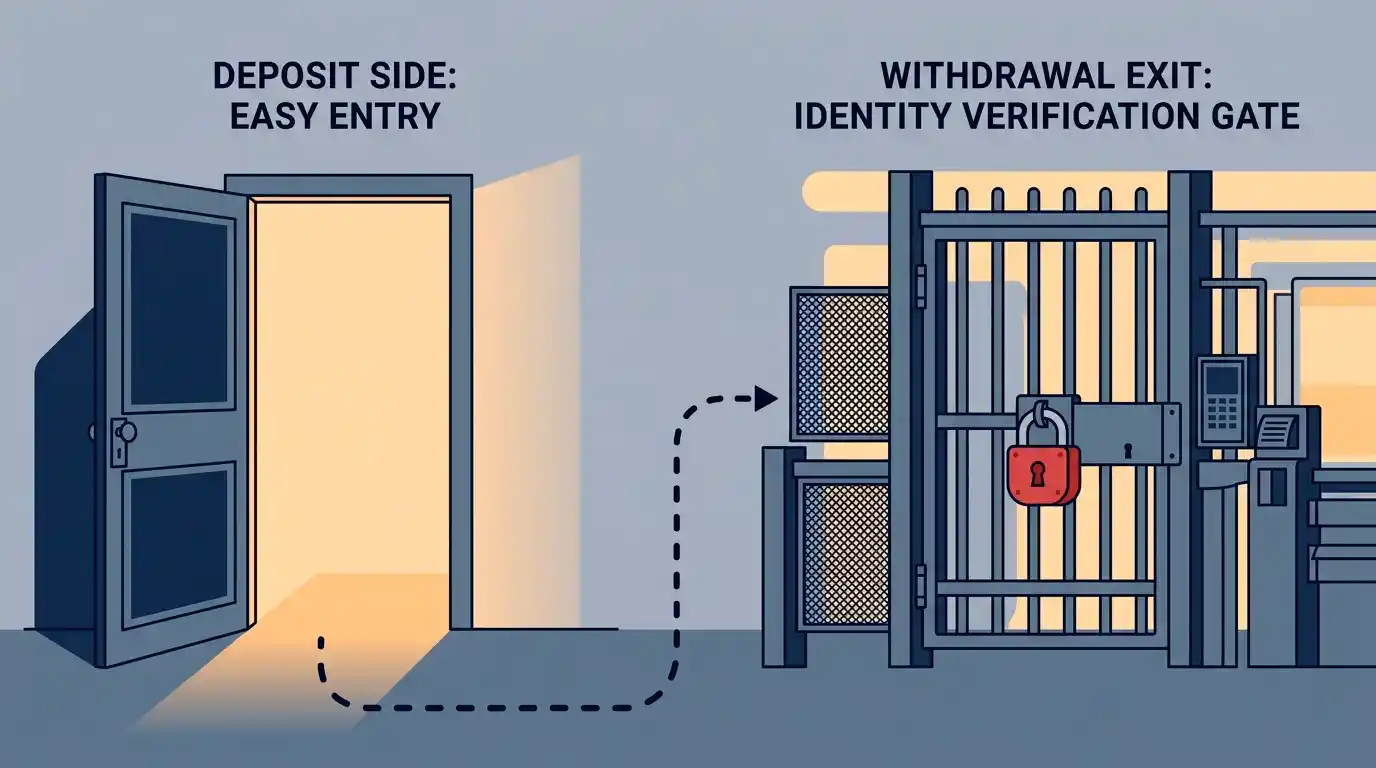
Crypto also enables a second pattern that is sold as privacy: play with no bank details and, on some sites, no upfront identity verification. The two go together. A site that never asks for a bank account can also delay asking who you are, which is marketed as frictionless but functions as deferral. The verification then tends to reappear at the worst possible moment, the withdrawal, where impossible or repeated document demands are a documented way to stall payouts. The no-bank-detail deposit and the deferred identity check are two faces of the same design, and we follow that thread in detail on no verification and crypto.
It is also worth being clear that GBP-denominated accounts, Faster Payments and UK customer support are not guaranteed on these sites. A casino may quote balances in crypto or in a foreign currency, settle withdrawals on its own schedule, and offer support only through a generic chat with no UK accountability. The convenience of getting money in quickly does not extend to getting help when something breaks, and there is no UK body standing behind the transaction.
Put the payment picture together before you act
The honest summary is short. Offshore casinos push crypto because crypto is the method the UK system is least able to block, and the same property that makes it hard to block makes it hard to recover. The regulated payment rails, narrowing further under the 2026 taskforce, exist partly to keep money away from operators that are acting unlawfully toward the UK market.

Choosing the workaround means choosing the version of payment with the fewest safeguards at the exact point you are most likely to need them. If your reason for looking at offshore payments is that your cards are being declined because of a self-exclusion, the more protective response is to strengthen the block rather than route around it, using the free tools described on our page about bank gambling blocks, and to return to the casino not on GamStop roadmap for the full picture.
If your cards are being declined for a reason
If you are searching for crypto deposits because your bank or cards keep declining gambling transactions, that block is often working as intended. Talking it through is the protective step. The National Gambling Helpline, operated by GamCare, is free and available 24 hours a day on 0808 8020 133 for residents of England, Scotland and Wales. Support and tools are available through GamCare and BeGambleAware, and the official self-exclusion scheme is at GamStop. Most UK banks also offer a free card-level gambling block you can switch on in seconds.
About the author
Daniel Ashworth is a gambling-regulation researcher who has spent more than a decade analysing how UK and offshore licensing frameworks shape online casino access. His work focuses on self-exclusion mechanisms, consumer-protection rules and the practical risks players face when they look beyond GamStop-registered operators. He writes plain-English explainers that translate licence conditions, regulatory consultations and case law into guidance ordinary readers can act on. He holds a recognised responsible-gambling practitioner certification and regularly references primary regulatory sources rather than secondary commentary. Read more on the about page.
This page is informational and is not tax or financial advice. Payment rules and enforcement change quickly; verify any dated detail against the linked primary sources before relying on it.
Why the checks arrive at cash-out: no-verification casinos.
Offshores
Published by the Casinoexitgamstop.com team.