

Pay-by-mobile uses a phone number and mobile account to fund a casino balance, with availability, limits and withdrawals governed by the cashier terms.
How Pay-by-Mobile Fits into a Casino Cashier
A casino cashier is not simply a list of logos. Each payment option represents a different route for moving money into the gambling account, with its own eligibility rules, limits, charges and withdrawal implications. Pay-by-mobile sits at the narrow end of that range: it uses a mobile number and the phone account behind it rather than a bank card or a separate e-wallet.
That distinction matters. A pay-by-mobile deposit can suit someone who wants to fund an account without entering card details, but it is not a general replacement for every cashier method. The available choice depends on what the operator has enabled for that account, the mobile network arrangement and the terms shown when the deposit is selected. A method mentioned on an information page is not enough to establish that it is active.
From the cashier’s side, the payment categories tend to serve different purposes:
- Debit cards connect the casino to a bank account and are commonly used for deposits.
- E-wallets such as Skrill and Neteller keep the casino transaction separate from the bank statement, although the wallet itself still has its own account and verification requirements.
- Prepaid products such as PaysafeCard use stored value rather than a bank-card transaction.
- Pay-by-mobile places the charge against a mobile contract bill or prepaid balance.
- Cryptocurrency methods rely on a separate digital-asset payment route and are only relevant where the cashier expressly supports them.
An independent current review lists Visa, Mastercard, Skrill, Neteller, PaysafeCard and several large cryptocurrency payment methods among the options found at some casinos. That is a description of the operators examined in that review, not a permanent list for the British market. Cashiers change, and the payment tiles displayed after login can differ from a general site page.
The practical difference from cards
Pay-by-mobile is often considered because it avoids supplying a debit-card number to the casino. That can make the initial choice feel more contained: the charge is associated with the mobile account rather than being taken directly from a bank account. The trade-off is that the mobile account becomes the funding source, so available credit, prepaid balance and network terms matter.
A debit card has a broader role in many casino cashiers. A specialist review describes debit-card deposits at UK casinos as free and more widely accepted than Payforit. The wording is important: it describes the comparison made by that review, not a guarantee for every operator. Where both methods appear, the debit card may provide a more familiar route, while Payforit may be selected for its phone-based authorisation and separation from card entry.
Credit cards are not an alternative for British online gambling deposits. UK Gambling Commission rules require remote gambling licensees to refuse credit-card funding for gambling. The restriction also covers arrangements in which a money service business is used as the route between the credit card and the gambling account. A card presented through an intermediary does not turn prohibited credit funding into an acceptable deposit.

This leaves debit cards and other permitted payment routes as the relevant comparison, not credit cards disguised under another label.
What “instant” really describes
Pay-by-mobile casinos are sometimes described as offering “instant” deposits. In operational terms, that usually refers to the casino balance being credited after the payment provider confirms the transaction. It does not mean that every related event is immediate, nor does it say anything about taking winnings out.
The cashier may accept a deposit promptly while still applying account checks, financial-limit controls or other operator conditions. Payment speed also does not expand the amount that can be funded through the phone account. A method can be quick and still be unsuitable for a larger bankroll or repeated deposits.
The same caution applies to phrases such as “no minimum deposit” or “no ID verification”. A promotional description cannot override the cashier’s live terms or the operator’s obligations. Deposit conditions are shown for the selected method, and age and account checks remain part of opening and using a gambling account. A payment option is not a route around identity controls.
The phrase “instant withdrawal” is especially misleading when attached to pay-by-mobile. The phone route is a deposit mechanism; it should not be treated as evidence that winnings can return to the mobile account. A cashier may present a separate bank, card, PayPal or e-wallet route for withdrawals, subject to the account details and checks required by the operator.
Where new payment labels fit
A newly advertised mobile casino or a new pay-by-SMS option still has to be assessed through the cashier rather than its wording. “New” may describe a recently launched operator, a newly added payment provider or simply a fresh marketing page. It does not establish that the method is active, suitable for withdrawals or available to every customer.
In my own cashier checks, the useful question has never been whether a logo appears in promotional copy. It is whether the logged-in deposit screen offers the method, states the applicable terms and shows what happens to the money after confirmation. Marketing describes the front door. The cashier shows the mechanism.
Pay-by-mobile therefore occupies a specific position: a phone-funded deposit route, convenient for accounts that meet its conditions, but narrower than a debit card and separate from the payout process. That is the context in which the individual provider options need to be read.
Payforit and Boku: What Happens at the Phone
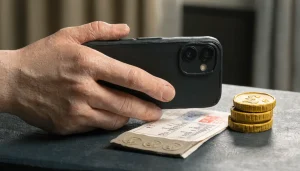
Pay-by-mobile deposits are authorised through the handset rather than through a card form or a separate wallet login. That distinction matters because the casino cashier starts the transaction, but the mobile service confirms it and applies the charge to the phone account. The phone number is therefore part of the payment route, not merely a contact detail.
I have seen these payments described as “instant” in casino copy. What that normally means is narrower: the deposit is confirmed through the mobile network and credited without the player entering bank-card details. It does not mean that every phone, tariff or casino cashier will support the method.
How a Payforit deposit is authorised
The Payforit flow has a clear sequence:
- Payforit is selected in the casino cashier.
- The mobile number is entered.
- Payforit sends an SMS containing a confirmation code.
- That code is submitted to authorise the deposit.
The code is the important control point. Selecting the method alone does not move money into the casino account. The transaction remains pending until the SMS confirmation is completed and accepted.
This also explains why Payforit is generally intended for mobile users. The service depends on access to the nominated handset and the ability to receive and respond to the confirmation message. A desktop can be used to reach a casino cashier, but the payment itself still relies on the mobile number and its associated account.
From the operator’s side, the casino records the deposit against the gambling account after the mobile payment has been confirmed. From the phone provider’s side, the charge is assigned to the mobile account connected with that number. The two records are linked by the payment request, but they are not the same account: a casino balance is created in one place, while the funding entry is handled through the phone service.
Contract phone or prepaid balance
The funding source depends on the type of mobile arrangement.
With a monthly contract phone, a completed Payforit deposit is added to a future phone bill. It appears as an extra charge alongside the ordinary mobile service costs. With Pay as You Go, the deposit is taken from the available prepaid balance instead. There is no later contract invoice for that payment; the relevant credit is reduced when the transaction is processed.
Contract vs Prepaid
With a monthly contract phone, a completed Payforit deposit is added to a future phone bill. With Pay as You Go, the deposit is taken from the available prepaid balance.
That difference can affect whether an authorisation succeeds. A contract account handles the charge through billing, while a prepaid account must have enough credit available. The casino cashier may accept the requested amount at the first stage, but the mobile account still has to support the charge when Payforit processes it.
The phone account also identifies who ultimately bears the cost. If a handset is shared or a contract is paid by another person, the casino account holder and the mobile account holder may not be the same individual. That is a practical issue worth resolving before a deposit is confirmed, because the casino balance and the phone bill are separate records.
Where Boku fits
Boku follows the same broad principle but uses its own payment flow. A deposit is initiated at the casino, and the transaction must then be confirmed by SMS before funds move. Until that confirmation is completed, the requested deposit has not been fully authorised.
The SMS is not a decorative notification. It is the step that gives the mobile payment service permission to proceed. If the message is not received, the confirmation is not submitted, or the transaction is declined, the casino should not treat the request as a completed deposit.
Boku can draw on a phone account in the same general ways as other pay-by-mobile arrangements: a contract charge is handled through the mobile bill, while a prepaid service relies on available phone credit. The exact presentation depends on the network and tariff. The key operational point is that the phone account must be able to support the charge when confirmation is given.

I treat the SMS stage as the dividing line between an attempted deposit and an authorised one. A cashier screen can show a request, but the money does not move merely because the amount was entered. Confirmation is required.
What the two methods do not change
Payforit and Boku replace card or wallet authorisation with mobile confirmation. They do not remove the casino’s own account controls. The casino still has to identify the gambling account and apply its cashier rules, while the phone service verifies the mobile transaction.
The payment also remains tied to the selected mobile number. Entering a number incorrectly can send the confirmation process to the wrong handset or prevent the message from arriving. A change of handset does not automatically change the mobile account behind the number, and a different number should not be treated as interchangeable with the one used in the cashier.
The wording in the SMS and the cashier should be checked together before confirmation: the casino account, requested deposit and mobile number need to correspond. Once the code is submitted, the phone service can process the charge and the casino can credit the account.
That is the whole mechanism in practical terms: the cashier requests, the handset confirms, and the phone account funds the deposit. Different route. Same scrutiny.
Which Casino Cashiers Accept Pay-by-Mobile
A casino may mention pay by mobile in a payment guide, help page or promotional panel without showing it as a funding option for every account. That distinction matters. The live cashier is the part of the site that determines whether Payforit can actually be selected at the point of deposit.
From the operator’s side, payment availability is not simply a branding decision. It can depend on the customer’s location, device, account status, mobile network and the methods enabled for that particular cashier. Payforit is generally intended for mobile players, so a desktop view or an account using a non-supported mobile arrangement may not display the same choices. A logo elsewhere on the site is not confirmation that the method is active.
I have seen payment pages remain unchanged while cashier settings moved on. That is why a general list of “supported methods” is weaker evidence than the deposit screen presented after login.
What to check in the cashier
The useful check begins after signing in and opening the deposit area. The payment tiles should be read as account-specific information, not as a promise made to every visitor. If Payforit appears as a selectable option, the cashier should then be checked for the conditions attached to it before any amount is entered.
The relevant details include:
- the minimum deposit accepted;
- the maximum value allowed for the transaction;
- any fee shown before confirmation;
- the financial-limit controls attached to the account;
- any notice explaining whether the deposit qualifies for a promotion.
The exact terms belong to the live cashier. They can differ between payment methods and can change as the operator updates its arrangements. A page describing Payforit in broad terms cannot replace those details.
The financial-limit point is easy to overlook because it may appear separately from the payment buttons. New remote customers must be given the opportunity to consider a financial limit before making a first deposit, and the account’s limit tools must remain available afterwards. In practical terms, the cashier and account controls should be reviewed together rather than treating the deposit button as the only relevant part of the process.
Operators mentioned in current reviews
A specialist review has identified Payforit at cashiers associated with Kwiff, NetBet, JackpotJoy and Virgin Games. These names indicate where the method has been reported, not a permanent guarantee that every account at each operator will display it.
That qualification is important for anyone comparing casino sites that accept pay-by-mobile deposits in the UK. Payment arrangements are capable of changing without the surrounding casino copy being rewritten at the same time. An operator can retain a Payforit reference in an information page while the method is unavailable to a particular account, or present it only after the correct mobile context is detected.
The sensible use of such a list is therefore as a starting point for checking, not as a final selection. The live cashier decides.
Why device and account context matter
Payforit is generally reserved for mobile players. That does not mean every phone, network or account will produce an identical cashier. The payment option may be absent when the site is opened on a computer, or the account may need to be viewed through a mobile connection before the relevant choice is shown.
The practical test is straightforward: sign in through the intended mobile setup, open the deposit cashier, and look for Payforit among the available methods. If it is not shown there, a mention in a review or an old operator page should not be treated as permission to deposit by that route. Switching between pages will not create an option that the cashier has not enabled.
This also prevents a common comparison error. A casino can accept cards, e-wallets or other listed methods while not accepting pay by mobile for the account being examined. Payment acceptance is method-specific. “Deposits accepted” is not the same statement as “Payforit deposits accepted.”
Before selecting a casino
A proper comparison records what the cashier shows at the time of checking and separates that observation from older descriptions. The operator name, the displayed Payforit option, the applicable limits, any stated charge and the available account controls all belong in the same assessment.
The method should also be treated as a deposit route only. Its appearance in the cashier does not establish that it can be used for withdrawals, and it does not override identity or account requirements. Those matters must be checked against the operator’s current terms and the payout options shown for the account.
The final decision is made at the payment screen, not in a banner. That is where “available” becomes real.
Using Pay-by-Mobile for Slot Deposits
Pay-by-mobile can fit slot play when the intended deposit is modest and the account already has an eligible phone-based method in its cashier. The practical attraction is narrow: the charge is attached to a mobile account rather than entered as a card transaction. That does not make the casino balance unrestricted, and it does not change the rules attached to the games.
The first constraint is the transaction ceiling. A specialist review identifies the Phone-paid Services Authority cap for Payforit deposits as £30 per transaction. That makes Payforit suitable for a small slot deposit, not for moving a larger bankroll into a casino account in one go. Repeated attempts would still be separate transactions subject to the cashier’s controls; the cap is not a feature to work around.

What the £30 ceiling means for slot play
Slot sessions can consume a balance quickly, particularly when several games are being tried. A Payforit deposit therefore needs to be considered as a limited funding step rather than as a general replacement for every casino payment route. The cashier may also apply its own minimum, account limit or eligibility condition, so the Phone-paid Services Authority ceiling does not tell the whole story.
I have seen the word “instant” used around Payforit deposits. What it really describes is the posting of the deposit to the casino balance after the payment has been authorised; it says nothing about the size of the available balance, the suitability of the method for a promotion or the route available for taking money back out. Those are separate account questions.
For slot customers, the deposit method also sits alongside the game rules. A phone-funded balance does not remove age checks, financial-limit prompts or the controls attached to licensed online gambling. It simply identifies how the initial money reaches the account.
Promotions are a separate decision
A payment can be accepted while being excluded from an offer. A specialist review reports that most UK casinos exclude Payforit deposits from welcome bonuses and other promotional offers. That wording should not be treated as a promise about every operator: the promotion’s own terms decide whether a Payforit-funded deposit qualifies.
This matters when the cashier presents a bonus alongside the deposit button. The presence of the offer does not prove that every listed payment method contributes to it. The relevant conditions may distinguish between cash deposits and deposits made through Payforit. If the deposit is made first and the terms are checked afterwards, the promotional decision may already be fixed.
The sensible comparison is therefore between two separate outcomes:
- whether Payforit can place money in the slot balance;
- whether that deposit is recognised for the particular promotion.
They are not interchangeable.
A workable use case
Pay-by-mobile is most coherent for a controlled, small slot deposit where the method is visibly enabled in the live cashier and no promotional qualification is being assumed. The £30 transaction cap keeps the exposure per payment defined, while the promotional exclusion prevents the deposit from being mistaken for a route to bonus funds.
My own rule is simple: treat the phone payment as funding, not as an offer. The cashier confirms acceptance; the promotion terms confirm eligibility. Two checks.
Pay-by-Mobile Casinos and GamStop: The UK Position
GamStop and pay-by-mobile address different parts of a gambling account. GamStop is a self-exclusion system; Payforit or Boku is a funding route linked to a mobile account. Paying through a phone does not change a player’s self-exclusion status, restore access to gambling, or create a separate category of casino account.
That distinction matters when phrases such as “pay-by-mobile casinos not registered with GamStop” are used. A casino being absent from a self-exclusion scheme is not evidence that it can lawfully serve British customers outside UK protections. Remote operators offering gambling to Great Britain must hold a UKGC licence, and online gambling is legal in the UK only through licensed and regulated sites. The payment method does not alter that position.
What GamStop status does — and does not — mean
GamStop concerns participation controls. It is not a payment filter and it is not a label for particular slots. Descriptions such as “pay-by-mobile slots with no GamStop” can therefore blur two separate issues: the game being played and the self-exclusion status of the account.

A phone-funded deposit is still a gambling deposit. It does not become acceptable merely because the charge appears on a mobile bill or comes from prepaid credit. Nor does selecting Payforit or Boku provide a route around an active self-exclusion decision. From the cashier’s side, the payment method identifies how funds are supplied; it does not cancel account-level restrictions.
I have seen “no GamStop” treated as if it were a useful feature. In practice, it is a warning that the wording needs unpacking.
Financial limits still belong in the account
There is also a separate control that applies before the first deposit. A new remote customer must be invited to think about setting a financial limit at that stage. The control cannot then disappear once the account is open: account-level limit tools must remain available afterwards.
That requirement is relevant to pay-by-mobile deposits because the phone account can make funding feel detached from the gambling balance. It is not detached. A charge to a monthly contract or a deduction from Pay as You Go credit still feeds the casino account and must sit within the operator’s account controls.
GamStop status does not replace those limits, and a financial limit does not replace self-exclusion. They serve different purposes: one restricts gambling access across participating accounts, while the other controls the funds available within an account.
The practical reading of “not on GamStop”
A casino described as not being on GamStop should not be treated as a recommendation or as a special pay-by-mobile category. For a UK customer, the relevant question remains whether the operator is permitted to offer remote gambling to the British market and whether the account’s protective controls apply.
Phone payment can make the funding step look simple, but it does not remove age checks, account restrictions, or the need to respect a self-exclusion decision. The payment label changes the source of the deposit, not the rules governing the gambling account.
Why Pay-by-Mobile Deposits Do Not Pay Out
Paying into a casino by phone does not create a matching route for taking money out. Payforit is designed for deposits: the charge reaches the mobile account or prepaid balance, while casino funds cannot be returned through Payforit. That distinction is easy to miss when the cashier presents the method beside cards and other payment choices.
A pay-by-mobile casino withdrawal therefore has to use a separate payout option shown for the account. A specialist review describes UK-licensed casinos as potentially offering withdrawals to a debit card, bank account, PayPal, or an e-wallet such as Skrill or Neteller. That is a description of possible routes, not a promise that every cashier provides each one. The live withdrawal screen decides what is available.
I treat the withdrawal page as part of the payment method, not as an afterthought. Before making a deposit, the relevant checks are:
- whether the account has a usable payout route;
- whether the selected route matches the account holder’s details and currency;
- whether identity verification or another account check remains outstanding;
- what the operator’s current terms say about withdrawals.
A fast withdrawal label does not remove those checks. A casino may need confirmation before releasing funds, and a route displayed for deposits may be absent from the withdrawal screen. The practical mistake is to assess pay by mobile only by how quickly money enters the balance.
The same separation applies when comparing Payforit with other payment methods. The phone payment can fund play, but the winnings leave through the casino’s approved payout process. An e-wallet may be offered for withdrawal even where Payforit was used for the deposit; a bank transfer or card route may appear instead. Nothing should be inferred from the deposit icon alone.
The wording in the cashier matters. A pay-by-mobile withdrawal UK search may suggest a direct phone payout, but Payforit does not provide one. The relevant question is narrower: which verified withdrawal methods does this particular account show now?
That is the real test. Deposit accepted; payout route separate.
Deposit Minimums, Caps and Phone Charges
Pay-by-mobile deposits are shaped by two separate controls: the casino’s cashier and the phone-payment service. The first sets the amounts it is prepared to accept; the second can impose a ceiling on each transaction. Treating the advertised figure as universal is how small deposits become failed deposits.
A specialist review describes Payforit deposits as having a minimum in the £3–5 range and a maximum of £30. That is useful as an indication of the transaction range, not as a promise applying to every operator. The cashier remains decisive: it may show a different minimum, restrict the method to particular accounts, or apply its own financial controls. The displayed terms should be checked before the amount is entered.
The £30 Payforit ceiling has a separate origin. The Phone-paid Services Authority sets that maximum per transaction, so a casino cannot turn Payforit into a larger single payment by changing its own cashier wording. Attempts to work around the cap are not a sensible payment strategy. A larger gambling balance would require a different payment route accepted by the account, subject to that method’s own terms.
The funding source also changes how the charge is felt. On a monthly contract phone, a Payforit deposit is added to a future mobile bill. With Pay as You Go, it is taken from prepaid credit instead. The casino balance may show the same deposit, but the household cost arrives differently. “No card required” does not mean “no payment obligation”.
Boku needs a separate check for charges. A specialist review notes that a mobile network can add a processing fee, with the amount depending on the network and tariff. That fee may mean the available phone credit must cover more than the casino deposit itself. A transaction can therefore fail even when the requested deposit appears affordable in isolation.

I check three figures in the live cashier: the minimum, the permitted maximum, and any disclosed network or service charge. Then I check whether the phone account can fund the full amount. Small payments still need exact terms.
How to Judge a Pay-by-Mobile Casino Offer
A meaningful comparison of a pay-by-mobile casino offer starts in the cashier, not in a banner promising the “best” mobile casino games paid through a phone bill. The payment logo matters only when the method is active for the account and its commercial terms are visible. I treat a method shown in a general help page as an indication, not confirmation.
A practical review should record four points before any deposit:
- whether Payforit or Boku is available in the live cashier;
- the minimum deposit and maximum transaction value displayed there;
- any fee attached to the deposit;
- which account-level financial controls can be set or changed.
Those details determine whether a pay-by-mobile phone casino suits the intended use. A low ceiling may fit occasional slot deposits but make repeated funding awkward. A fee can alter the real cost of a small transaction. A cashier may also present different terms after account verification or according to the selected phone network. The wording “simple” often means only that the charge is placed on the mobile account. The limits remain.
I also separate payment access from account controls. New remote customers should encounter a prompt to consider a financial limit before making the first deposit. That is not a decorative responsible-gambling message: it is part of the account setup. Afterward, the relevant limit tools must still be available, rather than disappearing once the deposit has been accepted.
A specialist review has reported that checking the live cashier for these fields is necessary because terms can change. I would use that advice as a checking method, not as proof that every operator applies identical conditions. The useful comparison is therefore not a ranked list of top pay-by-mobile casinos. It is a record of the actual cashier terms at the time of the proposed deposit.
For mobile casino games paid by phone bill, that distinction is decisive. The offer is only as suitable as its limits, charges and controls. જાહેરાત
Billing differences
Contract customers will see charges added to their future mobile bill, while Pay as You Go customers will see a deduction from their prepaid credit.
When a Casino Deposit Appears on the Phone Bill
A Payforit deposit does not appear as an ordinary card transaction. The charge follows the mobile account instead: a contract customer sees it added to a future phone bill, while a Pay as You Go customer has the amount taken from prepaid credit.
That distinction matters because the casino balance and the phone account record the same payment in different places. The casino cashier shows the deposit as funds credited to the gambling account. The network account carries the corresponding charge. In practical terms, a contract customer may notice it when the next bill is issued, whereas a prepaid customer sees the available balance reduced after the transaction.
I have seen “pay by phone bill” used as though it meant that every mobile casino deposit would be itemised in exactly the same way. It does not. The billing treatment depends on the type of mobile account and the network’s own presentation of paid services. The wording on a bill or account statement can therefore differ from the casino’s description of the deposit.

Payforit is the relevant route for this type of phone-funded casino payment. It is not a withdrawal account, and the phone bill should not be treated as a general-purpose wallet. The charge is tied to the mobile service used for the deposit.
Boku can create a separate billing issue. A specialist review reports that a mobile network may add a processing fee to Boku transactions, with the charge depending on the network and tariff. That is not a fixed amount that can be applied across every UK mobile account. The network’s current terms are the meaningful reference point.
This is why the phrase “included on the phone bill” needs careful reading. For a monthly contract, it describes how the deposit is collected. For Pay as You Go, it describes a deduction from existing credit. It does not mean the casino has granted credit, and it does not remove any payment condition shown in the cashier.
The bill is only one side of the record.

Boku, Phone-Bill Slots and the £30 Transaction Ceiling
Boku can appear as a pay-by-mobile option for casino deposits, including deposits intended for slot play, but its availability is not something a general payment-method page can settle. The relevant test is the operator’s live cashier. If Boku is not displayed after the account is opened and the payment options are loaded, it should not be treated as an available route.
A specialist review describes Boku deposits as subject to a standard maximum of £30 per transaction. That ceiling matters more with slots than the payment branding suggests: Boku is suited to a single small deposit, not to moving a larger bankroll in one payment. No workaround should be used to evade the cap. Separate transactions may also be subject to the casino’s own controls, and the cashier’s current terms take precedence over any general description.
The phone balance is another practical gate. A Boku payment can fail when the available phone credit does not cover both the chosen deposit and a network fee. That applies to prepaid credit and should also be checked against the tariff attached to the mobile account. A confirmation screen is not the same as available funds; the transaction still depends on the network accepting the full charge.
Boku is therefore not interchangeable with every other phone-funded option. Payforit, e-wallets and Paysafecard are alternatives mentioned in specialist payment coverage, but each has its own acceptance rules and account checks. A casino described as supporting pay by mobile may support Payforit without supporting Boku, or the reverse.
Promotions need separate attention. A pay-by-mobile deposit may not qualify for a casino offer, so a promo code cannot be assumed to change the payment limit or make Boku eligible for bonus terms. The decisive wording is in the operator’s current promotion and cashier pages.
My working rule is blunt: verify Boku in the cashier, check the displayed transaction ceiling and fees, and confirm that the phone account can fund the complete charge before authorising a slot deposit. Small route, firm limit.
Which UK casinos still accept Payforit in 2026?
Payforit is available at the cashiers of operators such as Kwiff, NetBet, JackpotJoy and Virgin Games. Check the live cashier to confirm it is offered for your account.
Why did my Payforit deposit fail at a UK casino?
A Payforit deposit may fail if you are not using a mobile account, or if your monthly bill or prepaid balance cannot cover the deposit. Check the cashier’s limits and your phone account balance.
Do all casinos accept Payforit?
No. Payforit is only offered by some casinos, so check the cashier after logging in to see whether it is available for your account.
How does Payforit work at a casino deposit?
Select Payforit in the cashier, enter your mobile number, then confirm the transaction using the code sent by SMS. The deposit is charged to your monthly phone bill or deducted from your Pay as You Go balance.
What are the withdrawal limits when using a Payforit casino?
Payforit cannot be used to withdraw casino funds. Check the cashier for the withdrawal methods and limits available to your account.
Are there fees for using Boku at online casinos?
A mobile network may charge a processing fee for Boku, and the amount can vary by network and tariff. Check the deposit terms and make sure your phone credit covers the deposit plus any fee.
Can I claim casino bonuses using Payforit?
Usually not: most UK casinos exclude Payforit deposits from welcome bonuses and promotional offers. Check the offer terms before depositing.
Can I use Boku on a pay-as-you-go phone?
Yes, if your prepaid credit covers the deposit and any network fee. Boku transactions also require confirmation by SMS.
Payments & Payouts: UK Casino Deposit Options
Prepared by the Casinoexitgamstop.com editorial staff.